Sanganeri vs Bagru vs Screen Print: How to Spot Authentic Hand Block Print
Sanganeri and Bagru are two genuine Rajasthani hand block prints made with carved wooden blocks pressed by hand; screen print is a machine mesh-stencil process often mis-sold as block print. This guide defines each, then gives concrete at-home tests to tell authentic handwork from a printed imitation before you pay.
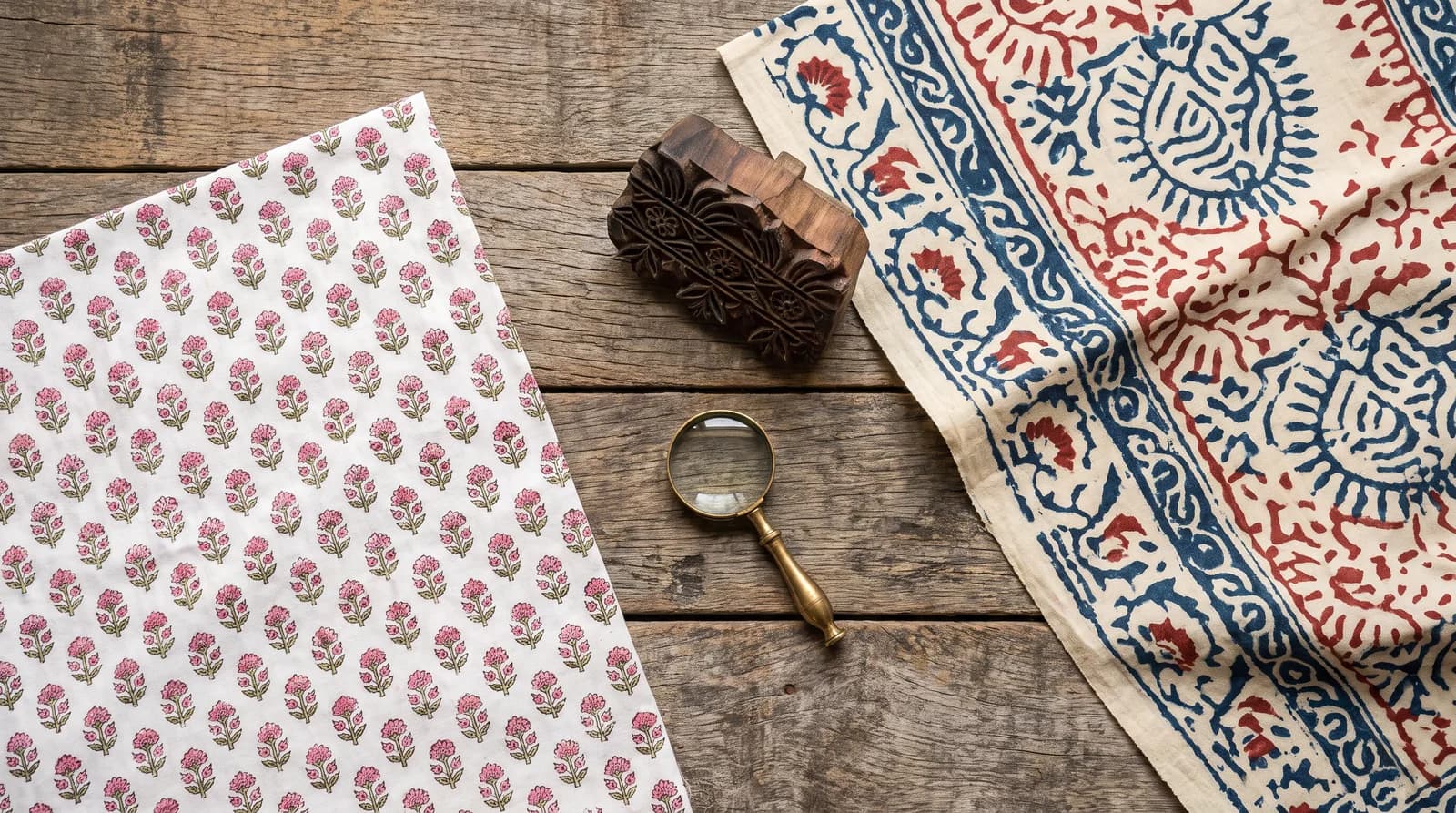
Sanganeri, Bagru and screen print in one glance
Sanganeri and Bagru are both authentic hand block prints from villages near Jaipur, made by pressing hand-carved wooden blocks onto cloth. They differ in look: Sanganeri is fine and delicate on a white ground; Bagru is earthier, geometric and famous for mud-resist dabu work in natural dyes. Screen print is not block print at all. It is a machine-driven mesh-stencil process using chemical dyes, mass-produced and frequently mis-sold online as "block print" at handwork prices.
If you remember one thing: genuine hand block print penetrates the cloth, so the motif shows clearly on the reverse, and it carries tiny human irregularities. Screen and digital prints sit on the surface, look machine-perfect, and are faint or blank on the back. Use the table below as your field guide, then read on for the at-home tests.
| Sanganeri | Bagru | Screen print | |
|---|---|---|---|
| Origin | Sanganer, near Jaipur | Bagru village, near Jaipur | Factory / power table, anywhere |
| Method | Hand block, carved wood | Hand block + dabu mud-resist | Machine mesh-stencil, semi-automatic |
| Typical motifs | Fine, delicate floral buti | Earthy, geometric, larger motifs | Any design, copied exactly |
| Ground colour | White / cream | Indigo blue, madder red, black, beige | Any, perfectly even |
| Dyes | Azo-free, disclosed | Natural / vegetable dyes | Chemical, undisclosed |
| Reverse side | Motif clearly visible | Motif clearly visible | Faint or blank |
| Price signal | Fair, reflects labour | Fair, reflects labour | Suspiciously cheap |
| GI status | GI 2009 | GI 2011 | None |
What defines Sanganeri hand block print
Sanganeri print takes its name from Sanganer, a town just south of Jaipur where the craft has been practised for centuries. Its signature is refinement: small, delicate floral buti motifs, closely repeated, printed on a white or cream ground. The white base is deliberate. It lets the fine linework and jewel-like flowers stand out, and it is one of the quickest ways to recognise Sanganeri against the darker grounds typical of Bagru.
Every colour in a traditional Sanganeri design is a separate hand-carved block, laid down in careful sequence. Because a human aligns each impression by eye, you will find gentle misregistration and faint block-join lines every nine to twelve inches. Those are not flaws; they are the fingerprint of real handwork. Sanganeri received its Geographical Indication (GI) tag in 2009, with the certificate issued on 19 March 2010, protecting the name against imitation.
Learn the craft in depth in our guide to what Sanganeri print is, understand the legal protection in our GI tag explainer, and study the vocabulary of flowers and borders in our motifs and designs guide.
What defines Bagru hand block print
Bagru, a village roughly 30 km from Jaipur, is the other great Rajasthani block-printing centre, and it has a very different personality. Motifs are bolder and more geometric, and the grounds are earthy rather than white: indigo blue, madder red, a distinctive black known as kashish, and the warm cream-and-black "syahi-begar" palette. Where Sanganeri whispers, Bagru speaks in strong, grounded tones.
Bagru's most famous technique is dabu, a mud-resist print. Artisans stamp a paste of mud, lime and gum onto the cloth wherever they want the dye to be blocked, then dip the fabric in natural dye. The covered areas resist the colour, and when the mud is washed away it leaves the pattern. This is slow, deeply hand-intensive work, and it is why real Bagru dabu carries soft, organic edges no machine can fake. Bagru earned its own GI tag in 2011.
If you love the indigo and mud-resist look, explore our Ajrakh and Bagru dabu collection and the indigo dabu collection, both printed with disclosed natural dyes.
Screen and digital print vs real hand block
This is where buyers get fooled. Screen printing pushes chemical dye through a mesh stencil, usually on a semi-automatic table, so one design can be repeated thousands of times, identically and cheaply. Digital printing goes further, spraying the pattern by inkjet for photographic uniformity. Neither touches a carved wooden block, yet both are routinely listed as "block print" online.
Why does it matter beyond honesty? Durability and depth. Hand block dye penetrates the fibre, so colour ages gracefully and the cloth keeps its character; screen and digital pigment often sits on top and can crack or flatten. And there is the human question: a hand block price supports a printer, a block carver, a dyer and a washer. A screen print supports a machine. If you are paying handwork prices, you deserve handwork. Here is how to check for yourself.
- 1Turn it over
The single most reliable test. On genuine hand block the dye soaks through, so the motif is clearly visible on the reverse, only slightly softer than the front. On screen or digital print the back is faint, patchy or nearly blank because the pigment sits on the surface.
- 2Hunt for misregistration
Look where two colours meet or a motif outline sits over its fill. Hand block shows tiny overlaps and gaps because a person aligned each block by eye. Screen and digital print are machine-exact, with edges that line up perfectly every single time.
- 3Find the block-join lines
A carved block is only a few inches across, so the printer repeats it across the width. Every nine to twelve inches you can often spot a faint join or a micro-shift in the repeat. A flawless, seamless repeat over a whole width is a red flag for a screen or roller.
- 4Read the irregularities
Scan for the human touch: a slightly heavier impression here, a hairline skip there, a buti that is a fraction off. These small inconsistencies are proof of hand printing. Absolute perfection across the whole cloth points to a machine.
- 5Use your nose and hands
Natural and azo-free dyes on hand block have a soft, earthy handfeel and little chemical smell. A strong plasticky odour or a stiff, rubbery patch where the colour sits on top of the cloth suggests chemical screen pigment.
- 6Apply price sanity, then ask
If a "block print" cotton is priced like machine goods, assume it is machine goods. Then ask the seller a direct question: what is the fibre, what dyes, and is it hand block or screen? An honest maker answers plainly and discloses; evasion is your answer.
For keeping genuine natural-dye handwork looking its best after you buy, follow our block print care and washing guide.
The price reality: why authentic costs more
Real hand block print is priced by labour, not by the metre alone. A single running metre may pass through several pairs of hands, block carving, printing colour by colour, dyeing and washing, before it reaches you. That is why genuine block-print cotton typically lands in a fair mid range, while a screen print copying the same design can be sold far cheaper. The table below shows rough, honest signals, not fixed prices, so you can sense-check a listing rather than be dazzled by a bargain.
| Genuine hand block cotton fabric | roughly Rs 549 to 899 per metre |
| Genuine dabu / natural-dye hand block | usually at the higher end and above, more hands, more steps |
| "Block print" priced like plain mill cotton | almost certainly screen or digital, not handwork |
| Suspiciously cheap bulk "block print" | treat as screen print until the seller discloses otherwise |
A low price is not automatically a scam, and a high price is not automatic proof of handwork. Use price as one signal alongside the reverse-side and repeat tests above. When all the signals agree, you can buy with confidence. Browse fairly priced pieces in our Sanganeri fabric category, block print bedsheets, and Jaipuri razai quilts.
How we guarantee what you are buying
We built this brand around one rule: we never sell screen print as handwork. Every piece described as hand block is exactly that, printed with carved wooden blocks by named artisan clusters near Jaipur. We do not blur the line between machine and hand to hit a price point, because that line is the whole point of buying block print.
We also disclose our dyes. Colours are azo-free and, on our natural-dye and dabu ranges, made with genuine vegetable and mineral dyes. You will find the fibre and dye information stated plainly, so you never have to guess whether the "eco" claim is real. Read the full promise on our authenticity guarantee page and the people behind it in our story.
For pieces whose provenance is documented against the Geographical Indication, start with our GI-certified Sanganeri collection or explore the broader natural dye collection.
Frequently asked
Last reviewed: 17 May 2026 · Verified by the Sanganeri print desk
Is Bagru better than Sanganeri?
Neither is better; they are different. Sanganeri is fine and delicate with floral buti on a white ground, ideal for lighter, dressier looks. Bagru is earthier and geometric, famous for mud-resist dabu in natural indigo, red and black. Both are genuine hand block prints with their own GI tags. Choose by the look and palette you want, not by a ranking.
How do I tell block print from screen print?
Turn the fabric over. Genuine hand block dye soaks through, so the motif is clearly visible on the reverse; screen and digital print are faint or blank on the back. Also look for slight misregistration, faint block-join lines every nine to twelve inches, and tiny human irregularities. Machine-perfect, seamless repeats with a blank reverse indicate screen or digital print.
Why is real block print expensive?
Because you are paying for labour, not just cloth. A single metre can pass through a block carver, a printer working colour by colour, a dyer and a washer. Natural-dye and dabu work adds even more steps. Genuine hand block cotton typically sits around Rs 549 to 899 per metre; anything priced like plain mill cotton is almost certainly screen or digital print.
Is machine or roller block print still real block print?
No. If a design is applied by screen mesh, roller or inkjet, it is not hand block print, however it is labelled. Real block printing means a hand-carved wooden block pressed onto the cloth by a human. Machine methods can copy the look but lack the dye penetration, the slight misregistration and the honest artisan value of true handwork.
Which is more durable, hand block or screen print?
Hand block often ages better because the dye penetrates the fibre rather than sitting on the surface, so colour softens gracefully instead of cracking. Screen and digital pigment can sit on top and flatten or crack over time. With gentle washing, quality hand block print in azo-free or natural dyes holds its character for years.
Do both Sanganeri and Bagru fade?
All natural and low-impact dyes mellow gently with time and washing; that soft ageing is part of their character, not a fault. Sudden, heavy fading usually points to cheap chemical screen pigment instead. To protect genuine handwork, wash in cold water, avoid harsh detergent and strong sun, and follow our block print care and washing guide.
Reviewed by the Sanganeri print desk
Written and reviewed with Sanganer's printing families. Every piece we make is GI-certified Sanganeri hand block print, stamped with azo-free dyes in Sanganer, Jaipur. Last updated 12 July 2026.