Sanganeri Motifs & Designs: Buti, Buta, Jaal & Bel Explained
Sanganeri motifs are the fine, realistic floral designs that define Rajasthan's Sanganer hand block printing: the scattered buti sprig, the larger buta or paisley kairi, the all-over jaal lattice, and the running bel vine border. Printed in delicate reds, pinks and greens on a white or cream ground, this motif vocabulary is what separates true Sanganeri from bolder, earthier Bagru work.
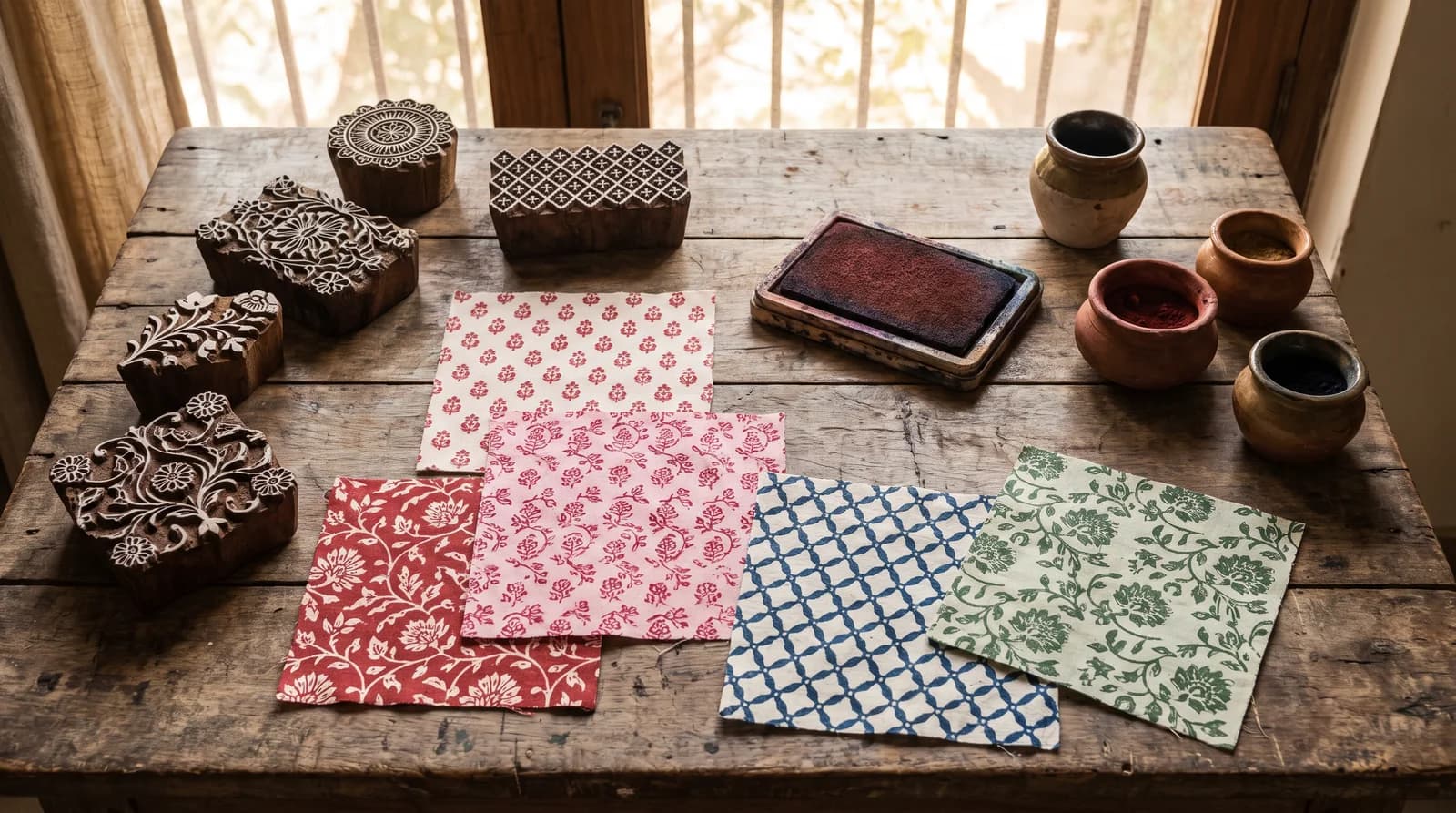
What defines the Sanganeri design language
Sanganeri design is best recognised by three things at once: fine, small-scale florals, a light white or cream ground, and delicate, almost botanical realism. Where many Indian block prints go bold and graphic, Sanganer near Jaipur built its four-century reputation on restraint. The classic Sanganeri cloth reads as a clean pale field lightly scattered with tiny, precise flowers, so the ground shows through and the motifs feel like they are floating rather than crowding.
That delicacy is deliberate and technical. Sanganeri printers favour fine outline blocks and closely observed flowers, roses, lotus, jasmine, lily and poppy among them, drawn small enough to repeat many times across a metre of cloth. The palette stays light and bright: reds, pinks, greens, blues and black outlines on white. This is the opposite of the earthier, indigo-and-madder look of nearby Bagru, and it is the single quickest way to tell the two traditions apart.
Once you learn the handful of motif families below, you can name almost any Rajasthani block print at a glance. The vocabulary is shared across sarees, suits, dupattas, bedsheets and running fabric, so the same words help you shop with precision. For the craft and history behind these designs, start with our explainer on what Sanganeri print is, and to place the style against its neighbours see Sanganeri vs Bagru vs screen print.
Sanganeri motif dictionary: buti, buta, jaal, bel & kairi
Almost every Sanganeri design is built from five motif types. Learn these and you can describe any piece accurately, buti versus buta is the distinction most shoppers get wrong, so it is worth reading the table slowly.
| Motif | What it is | Typically used on |
|---|---|---|
| Buti / booti | A single small floral sprig, scattered in neat repeating rows. The signature Sanganeri motif, fine and delicate on a white ground. | Running fabric, suit dupattas, everyday sarees, kidswear, light furnishings |
| Buta | A larger single motif standing alone or in a wider repeat, more detailed than a buti, often a flowering plant or cluster. | Saree pallus, kurta yokes, cushion centres, statement borders |
| Kairi / ambi | The mango or paisley shape, a curved teardrop bud. The Kashmiri version became European paisley. | Borders, buta fills, dupatta corners, festive suits |
| Jaal | An all-over interlacing lattice or net of vines and flowers that covers the whole cloth, as in a Mughal jaal. | Full-width fabric, lehengas, formal suits, furnishing panels |
| Bel / belbuta | A running floral vine that travels in a continuous line, the classic border creeper. | Saree and dupatta edges, selvedge borders, hemlines, sleeve trims |
The key pair is buti and buta. A buti (also spelt booti) is small, a single sprig repeated many times so the pale ground breathes between each one, this scattered spray is the truest Sanganeri look. A buta is its bigger sibling: one larger, more elaborate motif that carries weight on its own, which is why butas anchor saree pallus and kurta fronts. When a buti and a bel vine are paired along a border, printers call the combination belbuti, a term you will see on many dupattas.
A jaal is different in kind, not just scale. Instead of separate motifs sitting on open ground, a jaal is a continuous net of curving vines and flowers that interlaces edge to edge and fills the cloth. The Mughal-derived floral jaal is the most prized, giving a rich, all-over effect that suits formal suits and lehengas, browse the look in our Mughal jaal motif collection. The kairi or ambi, the mango-paisley bud, is the one motif that crosses all the others: it appears as a buta on its own, tucked inside a jaal, and marching along a bel border.
The floral vocabulary of Sanganeri print
What makes Sanganeri florals special is that they are observed, not stylised into abstraction. Printers depict recognisable garden and temple flowers with their petals, buds and leaves intact, then miniaturise them to buti scale. Knowing the common flowers helps you read a design's mood: a rose spray feels romantic and formal, a marigold reads festive, a lotus carries a quiet devotional weight.
| Rose (gulab) | The most beloved Sanganeri flower, full-petalled and romantic, printed as delicate open blooms and buds for a soft, feminine feel. |
| Lotus (kamal) | Layered petals with a serene, devotional quality, often larger and used as a buta or jaal centre. |
| Marigold (genda) | Round, ruffled and festive, its warm energy suits celebration wear and bright pieces. |
| Sunflower | A bold radiating bloom that gives a cheerful, open-faced motif, popular in contemporary ranges. |
| Jasmine (chameli) | Tiny star-shaped white flowers, ideal for the finest scattered buti and dainty borders. |
| Lily & poppy | Trumpet and cup shapes that add graceful variety, frequently drawn on curving stems. |
| Leaves & creepers | Fine foliage and running vines that connect motifs and form the backbone of every bel and jaal. |
Alongside flowers, contemporary Sanganeri workshops also print geometric checks and stripes, and animal and bird motifs, the peacock and elephant most of all, for playful and festive ranges. But the heart of the tradition remains the small realistic flower, repeated with patience, which is why a fine floral buti on white is still the design most people picture when they hear the word Sanganeri.
Colours and grounds: what they signal
In block print, the ground colour is as much a design choice as the motif. Sanganeri and Bagru, the two great Jaipur-area traditions, are separated as much by their grounds and palettes as by their patterns, and each colour choice carries a meaning you can learn to read.
| Style | Ground | Typical colours | Feel |
|---|---|---|---|
| Sanganeri | Light: white or cream | Red, pink, green, blue, with black outlines | Fine, fresh, delicate, feminine |
| Bagru | Earthy: beige, cream, indigo | Indigo blue, madder red, black kashish, natural beige | Rustic, grounded, bold, traditional |
| Dabu (Bagru technique) | Indigo or dyed | Indigo with resist-white patterning | Textured, folk, hand-worked |
The Sanganeri light ground exists to let fine florals sing: pale cloth gives maximum contrast to small motifs, so a scattered rose or jasmine buti stays crisp and legible. Reds and pinks lean festive and bridal, greens and blues feel calm and everyday, and the thin black outline, the rekh, gives every flower its clean definition. This is why Sanganeri is the go-to for summer suits and light sarees.
Bagru works the other way, using earthy grounds and mineral-and-plant dyes for a warmer, more rustic look. Its dabu technique paints a mud-and-lime resist onto the cloth before dyeing, so the covered areas stay pale and a pattern emerges from indigo, see the effect in our indigo dabu collection. If natural, azo-free colour matters most to you, our natural dye collection gathers pieces coloured with madder, pomegranate, indigo and iron rather than synthetics.
How a Sanganeri motif is built from blocks
A Sanganeri motif is not printed with one stamp. Each colour in the design needs its own hand-carved wooden block, and the printer lays them down in sequence, aligning each by eye so the flower comes together layer by layer. This is why a multi-colour buti has such life: it is assembled from three kinds of block.
- 1Rekh (outline block)
The first block stamped, carrying the fine outline that gives the motif its shape and definition, usually in black or a dark colour.
- 2Datta (filler block)
The fill blocks that drop colour inside the outline, the petals, leaves and centres. A design with several colours needs several datta blocks, one per colour.
- 3Gad (background block)
The block that lays down any background colour or ground fill around the motifs, used when the design calls for a coloured field rather than plain white.
The printer aligns each successive block against the last purely by eye and by small register marks carved into the block corners. A hair of overlap or a tiny gap where colours meet is the honest signature of hand work, not a flaw, and it is exactly what machine screen printing lacks. For the full making process, from block carving to washing and sun-drying, read what Sanganeri print is.
Choosing motifs for suits, sarees, bedsheets & fabric
Motif scale should match the piece. A design that looks perfect as running fabric can overwhelm a dupatta, and a border creeper that flatters a saree can look sparse on a bedsheet. Use this quick guide to match motif to purpose.
| You are buying | Best motif choice | Why |
|---|---|---|
| A suit or kurta | Fine buti all-over with a bel border, or a jaal for formal wear | Small repeats keep tailored garments elegant; a jaal reads richer for occasions |
| A saree or dupatta | A buta or kairi pallu with a bel-buti body | The large buta anchors the pallu while scattered buti keep the drape light |
| A bedsheet or furnishing | A bold jaal or larger buta repeat | Big surfaces need a bigger, all-over pattern to avoid looking empty |
| Running fabric by the meter | A versatile scattered buti | The most adaptable choice, cuts well for any garment without a fixed layout |
For garments, start with our fabric by the meter if you want to tailor your own, or browse ready pieces in Sanganeri sarees & dupattas and Sanganeri suits & apparel. If you love a particular colour story, the pink block print fabric and red block print fabric collections gather festive florals, while the Mughal jaal motif collection is the place for that rich all-over lattice.
Whatever motif you choose, the guarantee of genuine hand block work is the same: dye that soaks through to the reverse, gentle irregularities in the repeat, and natural, azo-free colour. Pieces in our GI-certified Sanganeri range carry that assurance formally, and our authenticity guarantee explains how we verify every print.
Frequently asked
Last reviewed: 17 May 2026 · Verified by the Sanganeri print desk
What is a buti motif?
A buti (also spelt booti) is a single small floral sprig, scattered in neat repeating rows across the cloth. It is the signature Sanganeri motif, deliberately fine and delicate so the pale white or cream ground breathes between each sprig. Buti designs are the most versatile, suiting fabric by the meter, dupattas and everyday sarees.
What is a jaal print?
A jaal is an all-over interlacing lattice or net of curving vines and flowers that covers the entire cloth edge to edge, rather than separate motifs sitting on open ground. The Mughal-derived floral jaal is the most prized, giving a rich, continuous effect that suits formal suits, lehengas and furnishing fabric.
What is the difference between a buti and a buta?
Scale and role. A buti is a small single sprig repeated many times so the ground shows between them, the classic delicate Sanganeri look. A buta is its larger sibling: one bigger, more elaborate motif that carries weight on its own, which is why butas anchor saree pallus and kurta yokes rather than filling a whole field.
What is bel in block printing?
A bel is a running floral vine, a continuous creeper motif that travels in a line rather than scattering. It is the classic border pattern, printed along saree and dupatta edges, hemlines and fabric selvedge. When a bel vine is paired with small buti sprigs, printers call the combination belbuti.
What is the kairi or paisley motif?
The kairi (also ambi) is the mango or paisley shape, a curved teardrop bud drawn from the mango fruit. It is one of the most enduring Indian motifs and the Kashmiri version travelled to Europe as paisley. In Sanganeri work it appears as a standalone buta, tucked inside a jaal, and marching along bel borders.
What motifs are typical of Sanganeri print?
Sanganeri is defined by fine, realistic small florals on a light white or cream ground: scattered buti sprigs, larger buta motifs, all-over jaal lattices, running bel vine borders and the kairi paisley. Common flowers include rose, lotus, marigold, sunflower, jasmine, lily and poppy. Modern ranges add geometrics, checks and bird or animal motifs like the peacock and elephant.
Reviewed by the Sanganeri print desk
Written and reviewed with Sanganer's printing families. Every piece we make is GI-certified Sanganeri hand block print, stamped with azo-free dyes in Sanganer, Jaipur. Last updated 12 July 2026.