Natural Dyes vs Azo-Free Pigments in Hand Block Printing: A Buyer’s Guide
Natural dyes are colours taken from plants, roots and minerals. In Sanganeri block printing, madder root gives red, vat-dyed indigo gives blue, and iron-rich mineral baths give the grey called kashish. Azo-free pigment dyes are synthetic colours made without azo compounds. The standard range at sanganeri.in uses disclosed azo-free dyes, and natural dye is the signature tier.
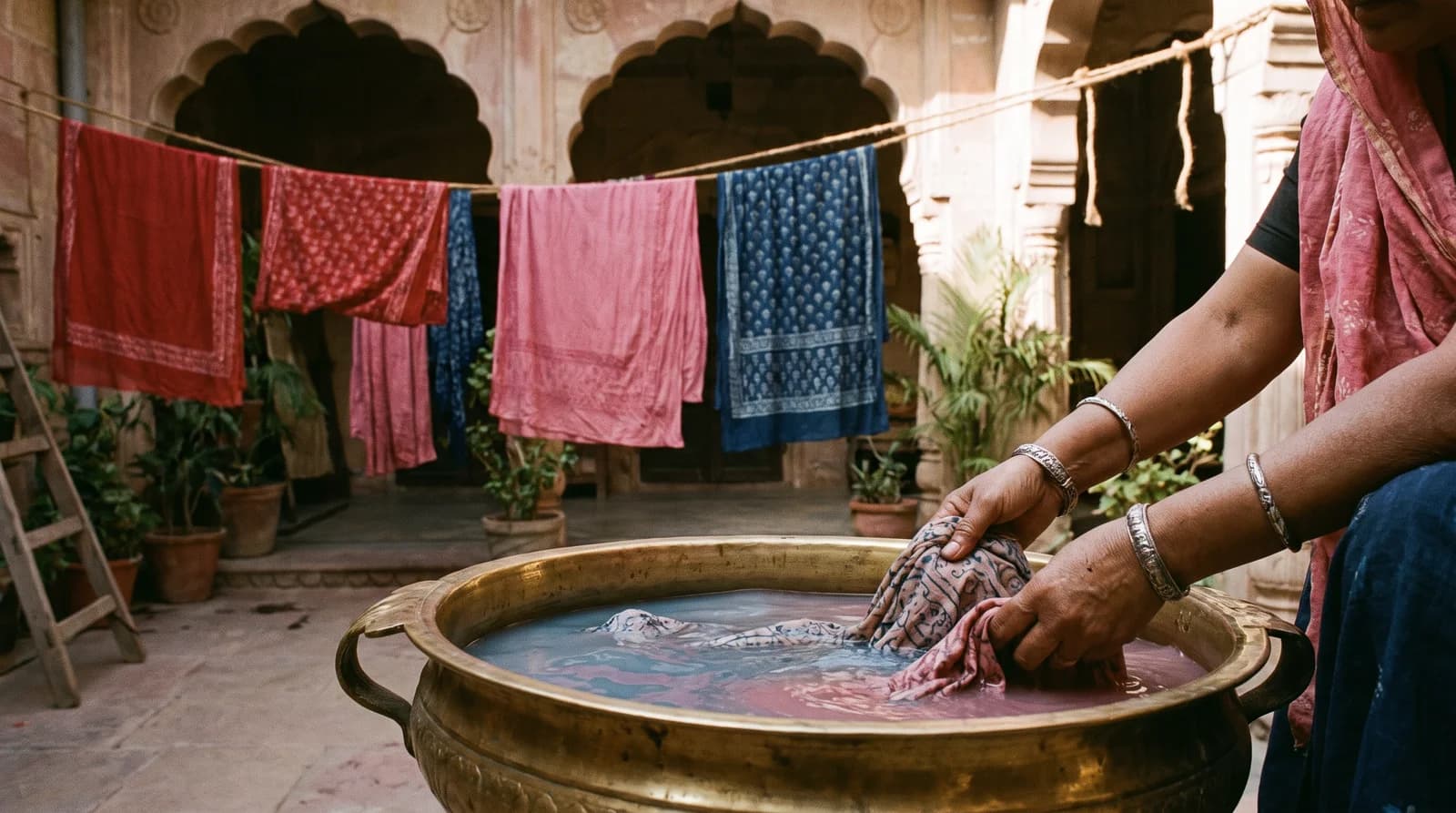
What is a natural dye, and what is an azo-free dye?
A natural dye is a colour taken from a plant, a root, an insect or a mineral source. In hand block printing the dye is usually mixed with a mordant, most often alum, so the colour bonds to the cotton and holds. The shade depends on the source, the mordant, the water and the number of dye baths, so no two natural-dye runs match exactly.
An azo-free dye is a modern synthetic colour or pigment system that is made without azo compounds. Azo is a large family of synthetic colours. Some azo dyes can break down and release restricted aromatic amines, and that concern is the reason ‘azo-free’ labelling exists. An azo-free dye is a chemistry statement. It does not mean the dye is natural, and a natural dye is not automatically the right choice for every buyer. Keep the two categories separate when you compare products.
| Madder red | Root of the manjistha plant, mordanted with alum |
| Indigo blue | Plant-derived indigo, vat-dyed so the blue builds in layers |
| Kashish grey | Cloth treated in iron-rich mineral baths |
| Azo-free pigment | Synthetic, made without azo compounds, disclosed per product |
Madder, indigo and kashish: what each colour is
Madder red comes from the root, not the leaf or flower. Printers use it for warm reds, rust and rose-brown tones. Because the colour comes from a root and depends on the mordant and the water, two batches cut from the same source can differ slightly. That variation is part of what a natural dye looks like.
Natural indigo is vat-dyed. The cloth is dipped in a vat where the indigo is reduced, and it turns blue only when it meets air. Repeated dips build the depth of the blue layer by layer. This is slower work than dipping in a synthetic dye, and it is one reason natural indigo is more expensive. Printing with a block on top of a natural base is also slower than a single flat colour pass.
Kashish is the soft grey that comes from iron-rich mineral baths. It is quieter than the reds and blues and sits well on the white or cream ground that Sanganeri printing is known for. Kashish is not a dye you can copy exactly with a single pigment, which is why it is a useful marker of a natural-dye piece.
| Colour | Source | Look | Over time |
|---|---|---|---|
| Madder red | Manjistha root | Warm, earthy red | Mellows toward a softer tone |
| Indigo blue | Plant indigo, vat-dyed | Deep, layered blue | May soften gradually |
| Kashish grey | Iron-rich mineral baths | Quiet, soft grey | Shifts gently |
How to tell a natural-dye piece from a chemical print
No visual test settles the question. A photograph cannot show you the dye chemistry, and a lab test is beyond most buyers. Use the checks below, in this order. Together they give a clear answer.
- 1Read the dye source on the product page
Start with the label. sanganeri.in discloses the dye source for each product. If the page says natural dye, it is a natural-dye product. If it says azo-free pigment, it is an azo-free product. If the source is not stated, ask before you buy.
- 2Check the shade range
Natural dyes rarely give a perfectly identical shade across pieces. A slight tonal difference between batches is normal. A uniform, glossy, very bright colour across a large order points more towards a synthetic pigment, though it is not proof on its own.
- 3Look at the motif, not only the colour
Hand block printing shows the slight misregistration and the faint join lines of the hand. A flawless machine-like repeat with no variation suggests a different process, whatever the dye.
- 4Compare the price band
Natural dye takes longer and produces more rejects, so it costs more to make. A very low price for a product sold as natural dye deserves a question about how it was made.
- 5Ask what the category name means
‘Azo-free’ and ‘natural’ are different claims. A seller who uses both words should be able to say which applies to which product.
Do natural dyes fade? What to expect as the cloth ages
Natural does not mean it never fades. Every dye changes with light, washing and time, natural and synthetic alike. What natural dyes tend to do is change tone rather than crack or turn dull grey. The change is usually gradual and even, and many buyers come to like the way a well-used piece softens.
| Indigo blue | May soften in tone over time |
| Madder red | Mellows toward a warmer, softer shade |
| Kashish grey | Shifts gently; no sharp greying expected |
| Washing | Cold water, shade dry |
| Sunlight | Keep prolonged direct sun off the cloth; sun speeds change in any dye |
If you want a bedsheet that keeps its first-day shade as closely as possible, an azo-free pigment piece may suit you better. If you want a cloth that ages in a visible, tonal way, the natural-dye tier is the better match. Both are valid choices. Pick the one that fits how you will use the cloth.
Why natural dye costs more, and what it means for the planet
Natural dyeing is slower and less predictable. It depends on plant and mineral sources, several mordanting and dyeing steps, drying between them, and repeat baths for depth. More pieces come out of the process with a shade that needs to be rejected. The price reflects that time. The natural-dye king bedsheet at sanganeri.in is priced at ₹3,999 to ₹4,499, and that band reflects the slower cycles and the higher number of rejects.
On sustainability, the honest description is this. Natural dyes come from plant, root and mineral sources, and sanganeri.in describes them as gentler on skin and soil. That is a fair statement about the materials. It is not a full lifecycle assessment, and we do not publish lab results or percentages for any batch. Azo-free pigments avoid azo compounds, which is a chemistry statement, not a complete environmental score.
| Factor | Natural dye | Azo-free pigment |
|---|---|---|
| Colour source | Plant, root or mineral | Synthetic, made without azo compounds |
| Shade consistency | Tonal variation between batches | More uniform across a run |
| Making time | Slower, with more rejects | Faster, more predictable |
| Price position | Signature tier | Standard range |
| Ageing | Tonal mellowing | Depends on the pigment system |
Are natural or azo-free dyes better for sensitive skin and children’s rooms?
Natural-dye pieces and azo-free dyes are both free of azo compounds, and the sanganeri.in range avoids harsh fixers in these tiers. For that reason we recommend natural-dye or azo-free pieces for sensitive skin and for children’s rooms. This is our recommendation, based on how the dyes are made. It is not a medical claim, and it is not a guarantee that a fabric will never cause irritation.
Some practical steps help. Wash new cloth before first use, as is general practice with any newly dyed fabric, and use cold water. If a child or an adult has a known dye allergy or a skin condition, check with a doctor before you choose a new bedding material. Test a small area of the fabric first if there is any doubt. A natural-dye bedsheet is still a cloth that needs care, so follow the wash guide.
Frequently asked
Last reviewed: 17 May 2026 · Verified by the Sanganeri print desk
What is the difference between natural dye and azo-free dye?
Natural dye is a colour taken from a plant, root or mineral source. Azo-free dye is a synthetic colour or pigment made without azo compounds. Azo-free is a chemistry statement and does not mean natural. Natural-dye pieces are free of azo compounds too, so the two can overlap, but they are not the same category.
Is natural dye block print better than azo-free print?
Neither is better for every buyer. Natural dye suits buyers who value a tonal, ageing look and a plant or mineral source. Azo-free pigment suits buyers who want a more uniform shade across a set. Both are free of azo compounds. Choose by the look and the use you want.
Do natural dyes fade?
Yes, over time and with light and washing. Natural does not mean it never fades. Natural dyes usually change tone gradually rather than cracking or turning dull grey. Indigo may soften, and madder reds mellow toward a warmer shade. Wash cold and shade dry to slow the change.
How can I tell if a block print is natural dye?
Start with the dye source on the product page, which sanganeri.in states for each product. Then look for slight tonal variation across pieces and a hand-printed motif rather than a machine-flat repeat. No visual test is a lab test, so the stated source is the most reliable guide.
Are natural dyes safe for children’s bedding?
We recommend natural-dye or azo-free pieces for children’s rooms and sensitive skin. This is a recommendation based on how the dyes are made, not a medical claim. If a child has a known dye allergy or skin condition, check with a doctor first and test a small area of new fabric.
Why is a natural dye bedsheet more expensive?
Natural dyeing takes more time, uses several mordanting and dyeing steps, and produces more rejects. The natural-dye king bedsheet at sanganeri.in is priced at ₹3,999 to ₹4,499, which reflects those slower cycles and the higher number of rejects.
What is kashish grey?
Kashish is a soft grey that comes from iron-rich mineral baths. It is one of the three natural colours in the sanganeri.in natural-dye tier, alongside madder red and vat-dyed indigo blue. It is quieter than the other two and sits well on a white or cream ground.
How should I wash a natural dye bedsheet?
Wash in cold water and shade dry, which helps the colour change gently rather than quickly. Wash new cloth before first use. Keep it out of prolonged direct sun. The full routine is in the block print care and washing guide.
Reviewed by the Sanganeri print desk
Written and reviewed with Sanganer's printing families. Every piece we make is GI-certified Sanganeri hand block print, stamped with azo-free dyes in Sanganer, Jaipur. Last updated 13 October 2026.