Vintage Kantha Throw Guide: What Kantha Is, How It Is Stitched, and How to Choose
Kantha is a traditional hand-stitched cotton textile from Bengal and eastern India. Soft cotton layers, traditionally reused cloth, are held together by a simple hand running stitch, and the stitching itself forms the pattern. A kantha throw is a light, layered piece where stitch density, texture and fabric mix vary from one piece to the next, so every piece is one-of-one.
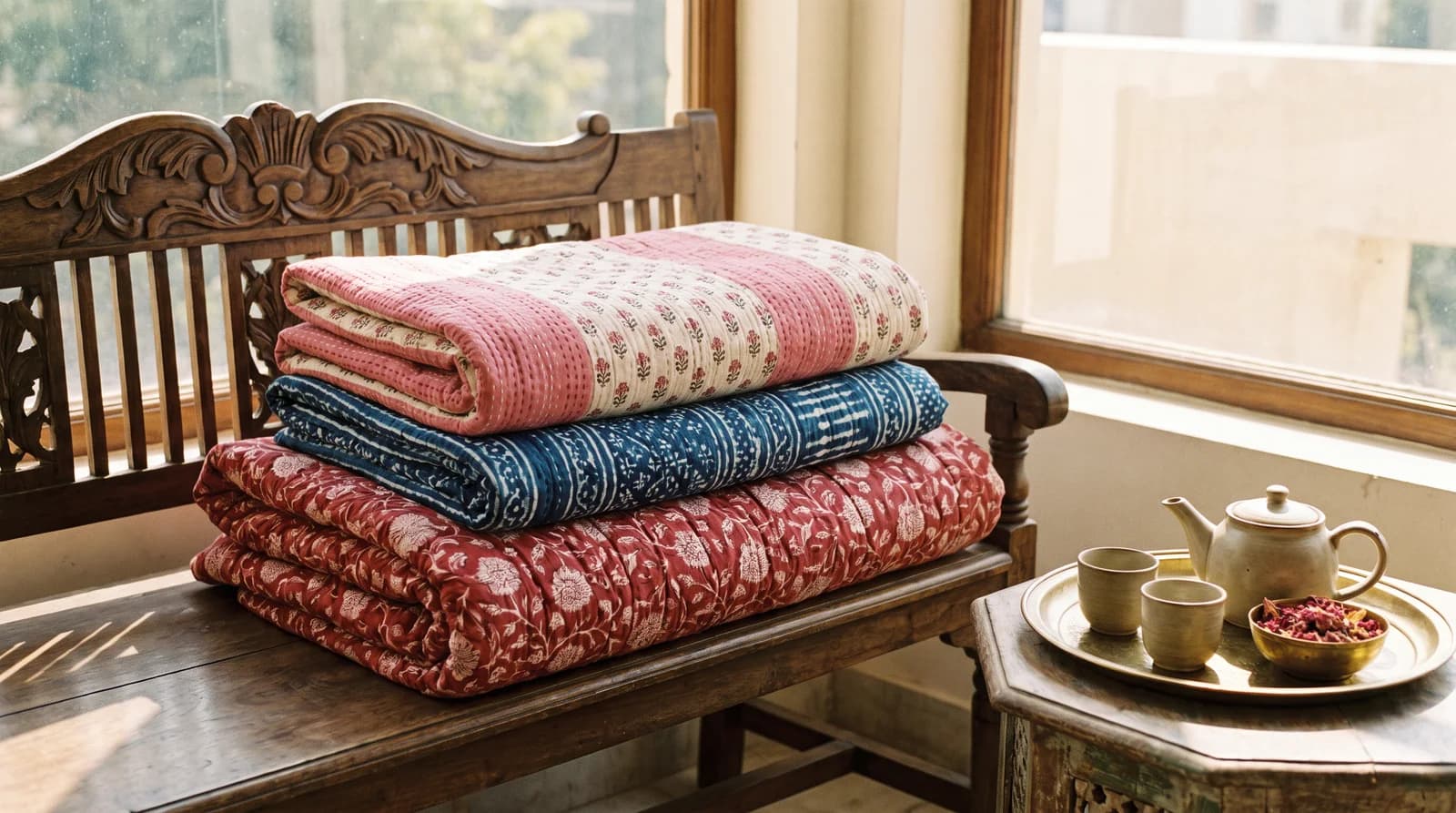
What is kantha?
Kantha is a hand-stitched cotton textile from Bengal and eastern India. It is made by working a simple running stitch, also called kantha, through several layers of cloth. The layers are held together by the stitching alone, so the surface gathers into a soft, rippled texture. Traditionally the layers were old cloth, often saris and dhotis, washed soft and stacked, which is why kantha feels worn-in from the first day.
A kantha piece is not a printed design. The pattern comes from the stitching: lines, borders, small motifs and open fields of stitch, all made by hand. Two pieces from the same maker can look quite different, because stitch density, texture and the fabric mix change from one to the next.
| Technique | Hand running stitch through stacked cotton layers |
| Traditional base | Reused cotton cloth, washed soft and layered |
| Origin tradition | Bengal and eastern India |
| Where the pattern comes from | The stitching, not a block or screen print |
| What varies by piece | Stitch density, texture and fabric mix |
How the hand running stitch is worked
The stitch is simple, and that is what makes kantha patient work. Each stitch is short, the thread passes through all the layers at once, and the stitcher pulls it gently so the cloth gathers. No two pieces are worked the same way, because no two stitchers hold the thread with exactly the same pull.
- 1Stacking the layers
Two or more layers of soft cotton are laid one on the other. The number of layers and the fabric mix decide how thick and warm the finished piece feels.
- 2Marking the design
The stitcher marks or follows a design, often in lines, borders or simple repeating motifs, and works across the cloth in rows.
- 3Running the stitch
A short running stitch passes through every layer. Closer stitches give a firmer, more textured surface. Wider stitches give a softer, lighter one.
- 4Finishing the edges
The outer edges are turned and secured so the layers do not shift in use. A neat, secure edge is one of the first things to check on any kantha piece.
Machine quilting looks different. A machine lockstitch is uniform in length and tension, so it reads as even and regular. Hand running stitch carries small variations in spacing and pull, and those variations are part of what makes it hand work. Stitch density is therefore a practical thing to look at when you judge a piece.
How to judge a vintage kantha claim
The word vintage is used loosely in home textiles. It can mean genuinely old cloth, a new piece made in an old style, or a new piece that looks worn on purpose. Sanganeri.in does not present its kantha pieces as antique or old textiles, and nothing in this guide says that it does. The useful question for any seller is what the word is attached to.
Before you accept a vintage label, ask three things: where the cloth came from, what evidence shows the stitching is old, and whether the seller says plainly what is old and what is new.
| What you see | What to ask for | What honest labelling looks like |
|---|---|---|
| Vintage or antique with no detail | The basis for the age claim and the source of the cloth | A stated basis, or a plain statement such as new, in the traditional style |
| Worn or faded look | Whether the wear is original or added | The seller says whether the wear is natural or created |
| Hand-stitched claim | Clear photos of both sides and the edges | Pictures that show the running stitch on the reverse as well as the front |
| Price well above the category | Why the price differs | A price that matches the cloth, the labour and the stitch described |
Be wary of any seller who cannot answer these questions in plain words. Honest labelling is simple to state: say what the cloth is, how it was made, and whether it is old or new.
Why each kantha piece is one-of-one
Every kantha piece is one-of-one. The stitch is worked by hand, the cloth layers are never identical, and the stitching shifts slightly from one piece to the next. Two throws cut from the same stack will not match stitch for stitch.
Product photos show a representative piece. They show the colour, the scale of the stitch and the general feel, but your piece is its own edition. Expect a small difference in density, texture and fabric mix from the picture. That difference is the nature of hand work, not a defect.
How to style a kantha throw on a bed or sofa
A kantha throw works in two main places. On a made bed, it sits on the top layer at the foot, or folds across the lower half. On a sofa, it is draped over one arm or the back, and its soft texture softens a hard frame.
First decide the job it is doing. A bedcover is the decorative top layer of a made bed, and a bedsheet is what you sleep on. If the bed already has a patterned bedcover, a plain kantha throw calms the look. If the bed is plain, the stitched texture becomes the focal point.
Fold the throw in thirds lengthways, then once or twice across, so the stitched face shows at the foot of the bed. On a sofa, fold it loosely over one arm and let one corner fall. Keep the texture visible rather than tucked away, because the stitch is what people look at.
Kantha throw or quilted bedcover set?
Sanganeri.in sells both, and they should not be confused. The category Quilted Bedcovers & Kantha runs from ₹2,999 to ₹6,499. Quilted bedcover sets are hand block printed, and their quilting lines are machine-run. Kantha is hand running stitch. The listings state this openly, so read the stitching line on each one before you buy.
| Feature | Kantha throw | Quilted bedcover set |
|---|---|---|
| Stitching | Hand running stitch | Machine-run quilting lines |
| Printing | Not print-led; the pattern is the stitch | Hand block printed |
| Price band | Within the ₹2,999 to ₹6,499 category range | King ₹5,999 to ₹6,499; double ₹4,999 |
| Care | Cold gentle machine wash, shade dry | Follow the care note on the listing |
How to care for a kantha throw
Sanganeri.in kantha throws and duvet covers are cold gentle machine wash and shade dry. Cold water on a gentle cycle is kinder to the stitching and the layers than a hot, hard cycle. Turn the piece inside out before washing, so the stitched face is not rubbed against the drum.
Shade drying matters for colour too. Dry the piece in shade, out of direct sun, and let it dry fully before folding. Press the water out gently instead of wringing it, and store it folded rather than in a tight, damp bag.
Handle the stitch the way you would any hand-worked textile. Keep it away from hooks and rough surfaces that catch the running stitch, and do not iron directly over the raised texture. Our block print care guide covers the same basics for printed cotton.
Frequently asked
Last reviewed: 17 May 2026 · Verified by the Sanganeri print desk
What is kantha?
Kantha is a traditional hand-stitched cotton textile from Bengal and eastern India. Layers of soft cotton, traditionally reused cloth, are held together with a simple hand running stitch. The stitching creates both the pattern and the soft, quilted texture, so the design is made by the needle rather than printed on the surface.
What is a kantha quilt or throw?
A kantha quilt or throw is a light, layered piece made with kantha stitching. A throw is used over a sofa, a chair or the foot of a bed. A quilt covers a bed. Stitch density, texture and fabric mix vary from piece to piece, so two pieces will never match exactly.
Is a vintage kantha throw really old?
Not always. The word vintage has no fixed meaning in home textiles. Ask the seller where the cloth came from, what evidence shows the stitching is old, and whether any wear is original or added. A plain, honest label such as new, in the traditional style, is a fair answer.
Why is each kantha piece different?
Kantha is worked by hand, so spacing, pull and stitch density change across every piece. The cloth layers are rarely identical either. Product photos show a representative piece, and your own throw is its own edition, with small differences from the picture.
What is the difference between a kantha throw and a quilted bedcover?
A kantha throw is made with hand running stitch. The quilted bedcover sets on sanganeri.in are hand block printed, and their quilting lines are machine-run, as the listings state. Check the stitching description on any listing, and read the care note before you buy.
How much do kantha quilts and bedcovers cost?
On sanganeri.in, the Quilted Bedcovers & Kantha category runs from ₹2,999 to ₹6,499. Quilted bedcover sets are priced at ₹5,999 to ₹6,499 for king and ₹4,999 for double. Prices depend on size and type, so check the listing for the exact price of the piece you want.
How do I wash a kantha throw?
Wash a kantha throw on a cold, gentle machine cycle, turned inside out. Dry it in shade, not direct sun, and press out water gently rather than wringing it. Fold it for storage once it is fully dry. The same care applies to sanganeri.in kantha throws and duvet covers.
What is the difference between a bedcover and a bedsheet?
A bedcover is the decorative top layer of a made bed. A bedsheet is what you sleep on, the layer that touches your body. A kantha throw or quilted bedcover belongs to the top layer, while the bedsheet sits underneath.
Reviewed by the Sanganeri print desk
Written and reviewed with Sanganer's printing families. Every piece we make is GI-certified Sanganeri hand block print, stamped with azo-free dyes in Sanganer, Jaipur. Last updated 13 October 2026.