Razai vs Dohar vs AC Quilt: Which Jaipuri Quilt Do You Need?
A razai is a thick cotton-filled quilt for real winter; the Jaipuri razai is famous for staying light yet warm. A dohar is a thin, breathable three-layer cotton quilt for summer, monsoon and AC rooms. An AC quilt sits in between - warmer than a dohar, lighter than a razai. This guide helps you pick the right one by season and room.
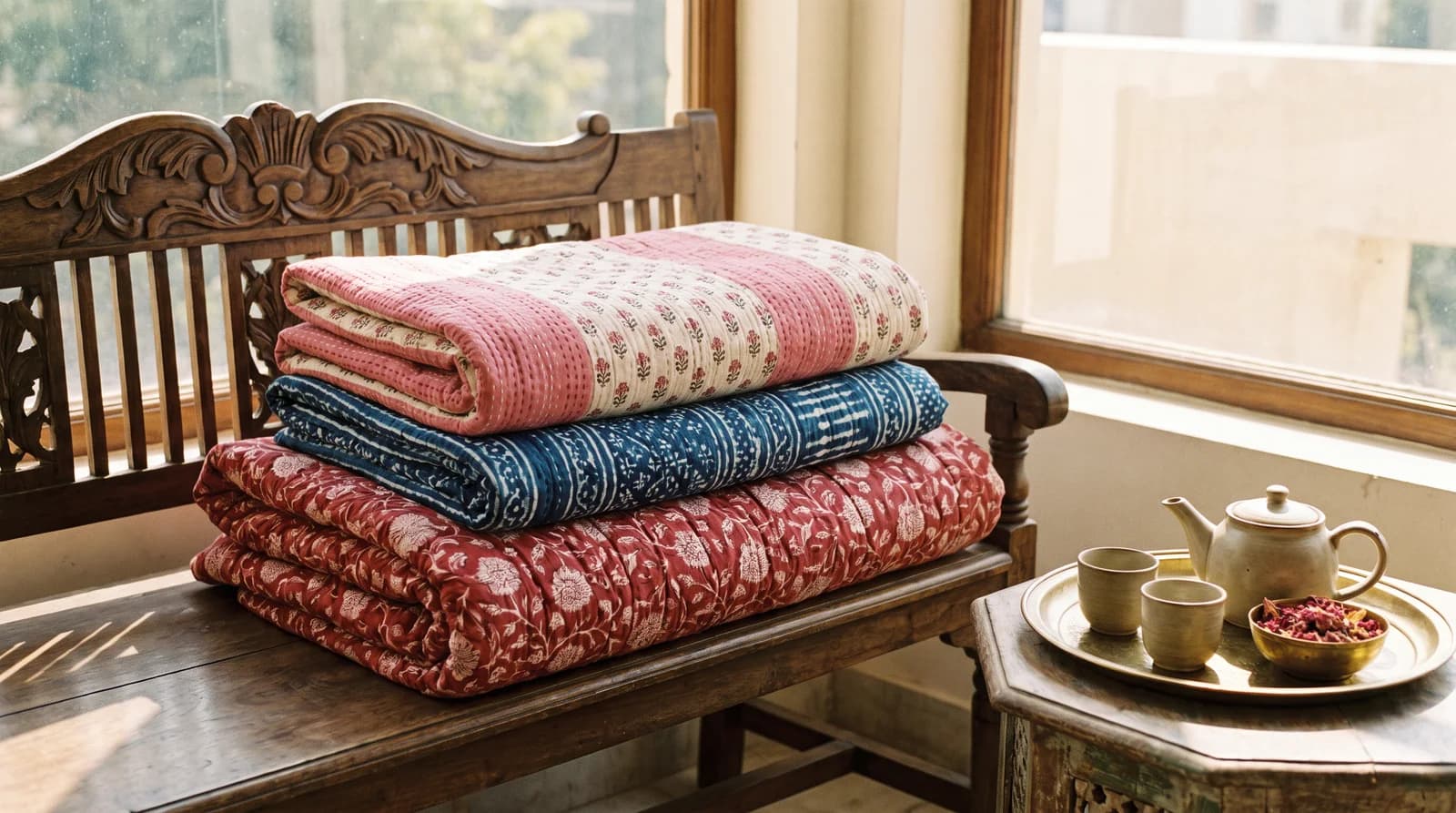
Razai, dohar or AC quilt - which do you need?
Think of these as a warmth ladder, coolest to warmest: dohar, then kantha bedcover, then AC quilt, then razai. A dohar is a thin, breathable three-layer cotton quilt for hot months, monsoon and AC rooms. An AC quilt is a light quilt sized to use under air-conditioning - warmer than a dohar. A razai is a thick cotton-filled quilt for genuine North-Indian winter, and the Jaipuri razai is the one prized for being light yet very warm.
If you buy only one and you live somewhere with a real winter, a good Jaipuri razai plus a mulmul dohar covers most of the year - the razai for the cold weeks, the dohar for everything else. If you rarely see a hard winter, a dohar and an AC quilt may be all you ever need. Here is the side-by-side view.
| Dohar | AC quilt | Razai | |
|---|---|---|---|
| Best season | Summer, monsoon, AC rooms | Spring, autumn, mild winter, AC year-round | Cold North-Indian winter |
| Warmth | Lightest - barely-there cover | Medium - a gentle layer of warmth | Warmest - true winter warmth |
| Filling | Thin cotton mulmul / voile layer | Light microfibre or light cotton fill | Fine hand-teased cotton batting |
| Weight | Very light | Light | Light for its warmth (fine Jaipuri) to heavy (coarse fill) |
| Layers | 3 (two printed layers + thin filling) | Shell + light fill, quilted | Printed cover + thick cotton fill |
| Machine / hand | Machine or hand-quilted | Usually machine-quilted | Traditionally hand-teased and hand-filled; cover hand block printed |
| Typical price band | Budget - lightest and least material | Mid | Mid to premium (fine Jaipuri razai costs more) |
The Jaipuri razai: light in the hand, warm on the bed
A razai (also spelt rajai) is a thick, cotton-filled quilt made for real winter. What makes the Jaipuri razai special is that it delivers that warmth without the dead weight most people expect from a quilt. The trick is the filling: fine, hand-teased cotton that is fluffed until it traps a lot of still air. Air is what actually keeps you warm, so a well-made Jaipuri razai can use surprisingly little cotton - sometimes as little as around 200 grams up to a kilogram - and still feel cosy on a cold night.
The outer cover is classic Jaipuri: soft cotton or voile, hand block printed in Sanganeri or Bagru floral patterns. The lightness is not a gimmick - it is the whole point. A cheap, heavy razai usually means coarse, poorly teased filling: more grams, more weight, and often less genuine warmth per kilo. So when you shop, do not judge a razai by how heavy it feels. Judge it by loft (how much it fluffs up) and the quality of the fill.
| Best for | Genuine cold winter (North India, hill stations, cold nights) |
| Filling | Fine hand-teased cotton batting |
| Cover | Hand block printed cotton or voile |
| Why it's warm | Fluffed cotton traps air - insulation, not weight |
| Weight myth | Light Jaipuri razai can be warmer than a heavy cheap one |
| Who needs it | Anyone facing real winter who wants warmth without heaviness |
Who needs a razai? Anyone whose winter genuinely drops cold - Delhi, Jaipur, Punjab, UP, the hills - and who wants to sleep warm without a heavy blanket pinning them down. It is the wrong tool for a Mumbai or Chennai bedroom, or for an AC room in summer, where it will simply be too warm. Browse the /collection/jaipuri-razai for hand-filled pieces, or the wider /category/jaipuri-razai-quilts range.
The mulmul dohar: a breathable summer quilt
Dohar meaning, in plain terms: a dohar is a lightweight, three-layer cotton quilt-cum-blanket. Two layers of printed cotton sandwich a thin layer of soft cotton mulmul (muslin) or voile in the middle - which is why the popular version is called a mulmul dohar. The three layers are quilted together, either by machine or by hand. The result is a cover that is soft, breathable and just warm enough for a mild night, without ever trapping heat.
That breathability is exactly why a dohar is the go-to for Indian summers, the monsoon, and air-conditioned rooms. It gives you a light sense of being covered - which most people want even in warm weather - while letting air move so you do not wake up sweaty. It is not built for deep winter: on a genuinely cold night a single dohar will not keep you warm, though many people layer two dohars, or a dohar under a razai, in the shoulder seasons.
| Best for | Summer, monsoon, AC rooms, mild nights |
| Construction | 3 layers - two printed cotton + thin cotton/mulmul filling |
| Feel | Soft, breathable, barely-there |
| Quilting | Machine-quilted or hand-quilted (we disclose which) |
| Not for | Deep winter on its own |
| Bonus | Doubles as a light throw / travel blanket |
A mulmul dohar is the single most versatile piece of bedding for most Indian homes, because so much of the year is warm. If you buy one quilt first, this is usually it. See the /category/mulmul-dohar range for printed cotton dohars, quilted honestly and labelled machine or hand.
The AC quilt / comforter: the warm-weather middle ground
An AC quilt - sometimes sold as a light comforter - fills the gap between a dohar and a razai. It is a light quilt, usually with a microfibre or light cotton fill, sized and weighted for use under air-conditioning in the warmer months. It is warmer than a dohar because it has a proper (if slim) layer of insulation, but far lighter than a razai. Think of it as the quilt for when a dohar feels too thin but a razai would be too much.
Where does it shine? An AC bedroom set to a cool temperature in summer, or the shoulder seasons - spring and autumn, and mild-winter cities where it never gets truly cold. In much of central and southern India, an AC quilt can be a genuine year-round quilt. Microfibre-filled versions are lighter and lower cost; a light-cotton fill breathes better and suits people who prefer natural fibres.
| Best for | AC rooms in summer, spring/autumn, mild winters |
| Filling | Light microfibre or light cotton fill |
| Warmth | Between a dohar and a razai |
| Weight | Light |
| Year-round? | Often yes, in mild climates |
| Pick microfibre if | You want the lightest, lowest-cost option |
The honest caveat: an AC quilt is not a winter quilt. If you sometimes get a properly cold spell, an AC quilt will leave you reaching for a blanket, and that is when a razai earns its place. Buy the AC quilt for the warm three-quarters of the year and let the razai handle the cold quarter.
Where kantha bedcovers fit in
A kantha quilt or bedcover is layered cotton held together with rows of running kantha stitch, worked by hand across the whole surface. On the warmth ladder it sits just above a dohar and below an AC quilt: it is a light, transitional-weather cover. But warmth is not really why you buy one - a kantha piece is chosen mostly as a decorative bedcover, a throw over the foot of the bed, or a light layer for cool evenings.
So treat kantha as the styling and light-cover option rather than a season solution. It is perfect for dressing a bed, for a reading nook, or for a mild night when you want texture and a little warmth without committing to a quilt. In a well-stocked bedroom it complements the working quilts rather than replacing any of them.
Explore hand-stitched pieces in the /category/quilted-bedcovers-kantha range, or the /collection/kantha-quilts-throws edit for throws that double as decor.
How to choose: match the quilt to your season and room
Work through these in order. The right answer is almost always driven by your coldest realistic night and the room you sleep in - not by the price tag or the weight.
- 1Start with your coldest night
Does your winter genuinely turn cold (North India, hills, cold nights below roughly 10 degrees)? If yes, you need a razai for those weeks. If your coldest night is only mildly cool, you can skip the razai entirely.
- 2Sleep in an AC room most of the year?
For an AC bedroom in summer, choose an AC quilt for a gentle layer of warmth, or a mulmul dohar if you run warm and just want a light cover. Both breathe far better than a razai, which will be too hot indoors.
- 3Hot, humid summers and monsoon?
A mulmul dohar is the answer - three light cotton layers that let air move so you do not overheat. It is also the best single piece for a warm-climate home that rarely needs anything heavier.
- 4Spring and autumn (shoulder seasons)?
An AC quilt covers most mild in-between weather. In a pinch, layer two dohars, or a dohar under a razai on a cool night, instead of buying a fourth quilt.
- 5Buying just for looks or a light throw?
A kantha bedcover dresses the bed and works as a light evening throw. Do not rely on it as your winter or summer quilt - it is a decorative, transitional layer.
- 6Remember: weight is not warmth
Do not judge a razai by how heavy it feels. A fine Jaipuri razai is warm because fluffed hand-teased cotton traps air, not because it is heavy. A heavy quilt often just means coarse filling. Judge by loft and fill quality, and check whether a piece is machine-stitched or hand-quilted - we disclose it, and we use azo-free dyes on the covers.
A simple three-quilt kit covers almost any Indian home: a mulmul dohar for summer and AC, an AC quilt for the shoulder seasons, and a Jaipuri razai for the cold weeks. Add a kantha bedcover if you want the bed to look finished. For fabric care once you have chosen, see the /learn/block-print-care-washing-guide, and if you are also buying sheets, the /learn/jaipuri-bedsheet-buying-guide pairs well with this one.
Frequently asked
Last reviewed: 17 May 2026 · Verified by the Sanganeri print desk
What is the difference between a razai and a dohar?
A razai is a thick, cotton-filled quilt made for genuine winter warmth; the Jaipuri razai is prized for being light in the hand yet very warm because its fine hand-teased cotton traps air. A dohar is a thin, breathable three-layer cotton quilt (two printed layers plus a thin mulmul filling) meant for summer, monsoon and AC rooms. In short: razai for cold winter, dohar for warm weather.
Is a dohar warm enough for winter?
Not for a real winter. A single dohar is a light, breathable summer cover and will not keep you warm on a genuinely cold night. In mild or shoulder-season weather you can layer two dohars, or use a dohar under a razai. But if your winter turns properly cold, you need a razai (or at least an AC quilt), not a dohar on its own.
What is an AC quilt?
An AC quilt is a light quilt - often with a microfibre or light cotton fill - sized to use under air-conditioning in warmer months. It sits between a dohar and a razai on the warmth ladder: warmer than a dohar, much lighter than a razai. It suits AC bedrooms in summer, the spring and autumn shoulder seasons, and mild-winter climates where it can serve year-round.
Why is a Jaipuri razai so light but still warm?
Because warmth comes from trapped air, not from weight. A Jaipuri razai is filled with fine, hand-teased cotton that is fluffed until it holds a lot of still air, which insulates you. A good one can use as little as around 200 grams to a kilogram of cotton and still feel warm. A heavy razai usually just means coarse, poorly teased filling - more weight, not more warmth.
Which quilt is best for an AC room?
For an AC bedroom in summer, an AC quilt gives a gentle, comfortable layer of warmth against the cool air. If you run warm or want the lightest option, a mulmul dohar works well too, since it breathes freely. Avoid a razai in an air-conditioned room in warm months - it is built for cold winter and will usually feel too hot.
Can I use a dohar in summer?
Yes - summer is exactly what a dohar is for. Its three light cotton layers (with a thin mulmul or voile filling) let air move, so you get the comfort of being covered without overheating. That is why a mulmul dohar is the go-to bedding for Indian summers, the monsoon and AC rooms, and often the single most useful quilt in a warm-climate home.
Reviewed by the Sanganeri print desk
Written and reviewed with Sanganer's printing families. Every piece we make is GI-certified Sanganeri hand block print, stamped with azo-free dyes in Sanganer, Jaipur. Last updated 12 July 2026.