What Is Sanganeri Print? The GI-Tagged Hand Block Printing of Jaipur, Explained
Sanganeri print is a traditional hand block printing craft from Sanganer, near Jaipur in Rajasthan, known for fine, delicate floral buti and buta motifs on a white or cream ground. Printers stamp hand-carved sheesham wood blocks onto cotton using azo-free or natural dyes. It received a Geographical Indication (GI) tag in 2009, protecting its name and method.
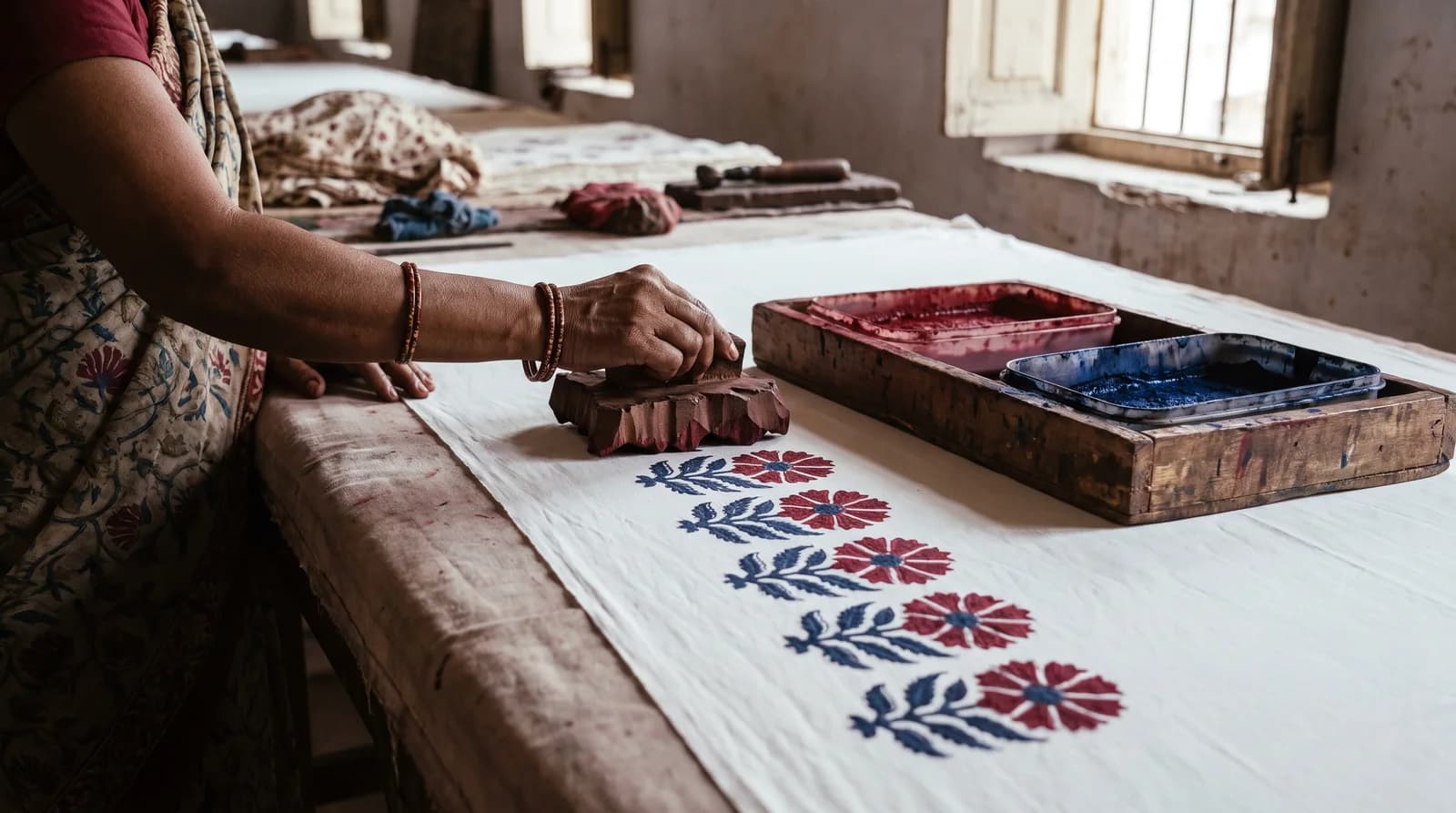
What is Sanganeri print, exactly?
Sanganeri print is a hand block printing tradition from the town of Sanganer, just south of Jaipur in Rajasthan. Its signature is fine, delicate floral work – small repeating buti (single flower motifs) and flowing buta and bel (larger blooms and vines) – usually printed in bright, clear colours on a white or cream cotton ground. Every design is stamped by hand using carved wooden blocks, one colour and one impression at a time.
What separates Sanganeri from ordinary printed cloth is that the colour physically penetrates the fabric: because the block is pressed through, the motif shows on the reverse of the cloth too. Sanganer printers are historically famous for calico printing and do-rukhi work (printing cleanly on both sides). The look is refined and light rather than bold and rustic – that fineness is the town's calling card.
| Origin | Sanganer town, near Jaipur, Rajasthan |
| Motif signature | Fine floral buti / buta / jaal / bel |
| Ground colour | Typically white or cream cotton |
| Dyes | Azo-free pigments or natural dyes (indigo, madder) |
| Base cloths | Cotton, mulmul (muslin), voile, cotton-silk |
| GI tag | Granted 2009 (certificate issued 19 March 2010) |
| Typical products | Fabric, suits, sarees, dupattas, bedsheets, razai |
Origin: how Sanganer became the fine-print centre
Sanganer sits on the banks of the Saraswati river (locally the Amanishah nala), a short drive from Jaipur. That water is central to the story. Its particular mineral quality suited the washing and fixing of dyes, giving Sanganeri cloth a clean, bright ground and helping the reds and blacks set fast – which is exactly why the craft concentrated here rather than anywhere else.
The craft grew under Mughal-era and later Rajput court patronage. As Jaipur rose as a planned capital in the eighteenth century, its rulers encouraged crafts communities to settle nearby, and printing and dyeing families – the chhipa printers – moved into Sanganer. Court demand for fine printed cotton for garments and furnishings pushed local printers toward ever more delicate, detailed floral work, distinct from the earthier prints of surrounding villages.
Over generations this became a specialised ecosystem: block carvers cutting sheesham (rosewood) blocks, printers working long tables, and washer-dyers managing the riverside fixing and rinsing. That division of skilled labour is why Sanganer, and not a bigger city, remains the reference point for fine hand block printing in India. Nearby Bagru developed a parallel but distinct earthier tradition using mud-resist dabu and natural dyes.
How Sanganeri print is made, step by step
Sanganeri printing is slow, sequential handwork. A single running-metre design can involve several blocks and repeated passes down a table, with drying and fixing in between. Here is the sequence in the order a workshop actually follows.
- 1Block carving
A carver hand-cuts the design into a block of seasoned sheesham (rosewood). A complex motif needs separate blocks per colour – an outline block, one or more fill blocks and a background block – each carved to register with the others.
- 2Base-cloth preparation
Greige cotton is washed (de-starched), sometimes bleached to the clean white ground Sanganer is known for, and dried. Cloth destined for natural dyes may be treated with a mordant so the colour bonds and stays fast.
- 3Laying the table
The fabric is stretched and pinned taut over a long, padded printing table so it cannot shift. A flat, even surface is what lets the printer keep the repeat aligned over many metres.
- 4Printing the outline (rekh)
The printer dips the outline block into the colour tray and lays down the rekh – the fine outline that defines the motif. Registration is judged entirely by eye, block by block, working across and down the cloth.
- 5Filling and background (datta and gad)
Further blocks add the datta (colour fills inside the outline) and, where needed, the gad (background). Each colour is a separate pass; slight misregistration and a faint block-join line every 9 to 12 inches are the honest signature of the hand.
- 6Fixing, washing and drying
The printed cloth is cured or steamed to fix the dye, then washed to remove excess colour and any resist, and finally sun-dried. Natural-dye cloth may be boiled with mordants and dyes to develop and lock the final shades.
Sanganeri motifs: a floral vocabulary
Sanganeri design is overwhelmingly floral and finely scaled. The core vocabulary is worth knowing because it is how the craft is described in the trade: buti (a small, single scattered flower motif), buta (a larger flowering plant or bloom), jaal (an all-over trellis or net of connected flowers and vines) and bel (a running floral border). These are arranged in neat repeats on the light ground that makes the colours read clearly.
You will also see Mughal-influenced jaal work, paisley (kairi/ambi) forms, and stylised roses, marigolds, lotus and creepers. The restraint is the point: motifs stay small and precise, colours stay clean, and the white space is left to breathe. For the full motif-by-motif breakdown, see our dedicated guide.
Read next: our detailed walk-through of the motif families and how to read a print at /learn/sanganeri-motifs-designs-guide.
The GI tag: what 2009 actually protects
Sanganeri hand block print holds a Geographical Indication (GI) tag, granted in 2009, with the certificate issued on 19 March 2010. A GI is a form of intellectual property that ties a product's name to its place of origin and traditional method. In practical terms, only hand block printing produced in the Sanganer region, following the recognised craft, can rightfully be sold as genuine Sanganeri print.
The GI matters to buyers because it draws a hard line between authentic regional handwork and machine or screen prints marketed with the same name. It protects the artisans' collective reputation and gives shoppers a reference for what the term is supposed to mean. Nearby Bagru print received its own separate GI in 2011.
| GI granted | 2009 |
| Certificate issued | 19 March 2010 |
| What it protects | The name and traditional method, tied to origin |
| Region | Sanganer, near Jaipur, Rajasthan |
| Related GI | Bagru hand block print (GI in 2011) |
For a plain-language explainer of how the GI works and how to verify it, see /learn/gi-tag-sanganeri-print-explained.
Sanganeri vs Bagru vs screen print
Three things get muddled in the market: Sanganeri, its neighbour Bagru, and machine screen prints that merely imitate the look. They are genuinely different in ground colour, dye method and, most usefully, in what the back of the cloth looks like.
| Feature | Sanganeri | Bagru | Screen print |
|---|---|---|---|
| Method | Hand block, wood | Hand block, wood | Machine / screen mesh |
| Ground colour | White / cream | Earthy beige, indigo, red | Any (uniform) |
| Dye style | Azo-free / natural, bright | Dabu mud-resist, natural dyes | Synthetic, sits on surface |
| Motifs | Fine, delicate florals | Bolder, geometric, earthy | Any, perfectly repeated |
| Reverse of cloth | Motif shows through | Motif shows through | Blank / faint on back |
| Human signature | Slight misregistration, join lines | Slight misregistration, join lines | Flawless, mechanical repeat |
The quickest field test: turn the cloth over. Hand block print penetrates the fabric, so the motif is visible on the reverse; a screen print is uniform and largely blank on the back. For the full comparison, see /learn/sanganeri-vs-bagru-vs-screen-print.
Why it matters and where to use Sanganeri print
Because Sanganeri is printed on breathable cotton and mulmul, it turns into a huge range of everyday and festive products: running fabric by the metre, unstitched and stitched suits, sarees and dupattas, bedsheets, and the classic lightweight Jaipuri razai quilt. The fine florals and clean ground make it as at home in a modern wardrobe as in a traditional trousseau.
| Running fabric | Dressmaking, home furnishing – /category/sanganeri-fabric |
| Apparel | Suits and kurtas – /category/sanganeri-suits-apparel |
| Drape | Sarees and dupattas – /category/sanganeri-sarees-dupattas |
| Bedding | Block-print bedsheets – /category/block-print-bedsheets |
| Quilts | Jaipuri razai – /category/jaipuri-razai-quilts |
The buyer value is simple: you are paying for real handwork, breathable natural cloth and dyes disclosed honestly. That only holds if the seller is honest. Our rule is plain – we never sell screen print as handwork, we disclose azo-free versus natural dyes, and we price without fake-discount theatre. See how we back that with our /trust/authenticity-guarantee, and browse verified pieces in our /collection/gi-certified-sanganeri edit.
Frequently asked
Last reviewed: 17 May 2026 · Verified by the Sanganeri print desk
What is Sanganeri print?
Sanganeri print is a traditional hand block printing craft from Sanganer, near Jaipur in Rajasthan. Artisans stamp hand-carved wooden blocks onto cotton to create fine, delicate floral motifs, usually on a white or cream ground, using azo-free or natural dyes. It carries a Geographical Indication (GI) tag granted in 2009.
Where is Sanganeri print made?
It is made in and around Sanganer, a town just south of Jaipur in Rajasthan, India. The craft settled there partly because the local river water suited dye washing and fixing. Generations of block carvers, printers and dyers still work there, which is why Sanganer remains the reference point for fine hand block printing.
What is the difference between Sanganeri and Bagru print?
Both are Rajasthani hand block prints, but Sanganeri is fine and delicate on a white or cream ground with bright florals, while Bagru is earthier, using mud-resist dabu and natural dyes on beige, red or indigo grounds with bolder, more geometric motifs. Sanganeri got its GI in 2009; Bagru received its own in 2011.
How can I tell if Sanganeri print is really hand made?
Turn the fabric over. Genuine hand block print penetrates the cloth, so the motif is visible on the reverse. You will also see tiny, honest imperfections – slight misregistration between colours and a faint block-join line roughly every 9 to 12 inches. A screen or machine print looks flawless and is blank or faint on the back.
Does Sanganeri print fade or bleed?
Properly fixed Sanganeri print is colourfast for normal wear. Natural-dye and hand-printed cloth may release a little excess colour in the first one or two washes, which is normal. Wash it gently in cold water, separately at first, avoid harsh detergent and long sun exposure, and it holds well. See our block-print care and washing guide for details.
What products are made from Sanganeri print?
Sanganeri print is used for running fabric by the metre, suits and kurtas, sarees and dupattas, bedsheets, and the lightweight Jaipuri razai quilt. Because it is printed on breathable cotton and mulmul, it works for both everyday clothing and festive or trousseau pieces, as well as home furnishings.
Reviewed by the Sanganeri print desk
Written and reviewed with Sanganer's printing families. Every piece we make is GI-certified Sanganeri hand block print, stamped with azo-free dyes in Sanganer, Jaipur. Last updated 12 July 2026.