The GI Tag of Sanganeri Print (2009), Explained
A Geographical Indication (GI) is a legal sign under India's GI Act, 1999 that ties a product's name to its place of origin. "Sanganeri Hand Block Printing" received GI status in 2009, with the certificate issued in March 2010. This guide explains what the tag protects, why a GI logo alone is not a full guarantee, and how buyers really verify an authentic Sanganeri piece.
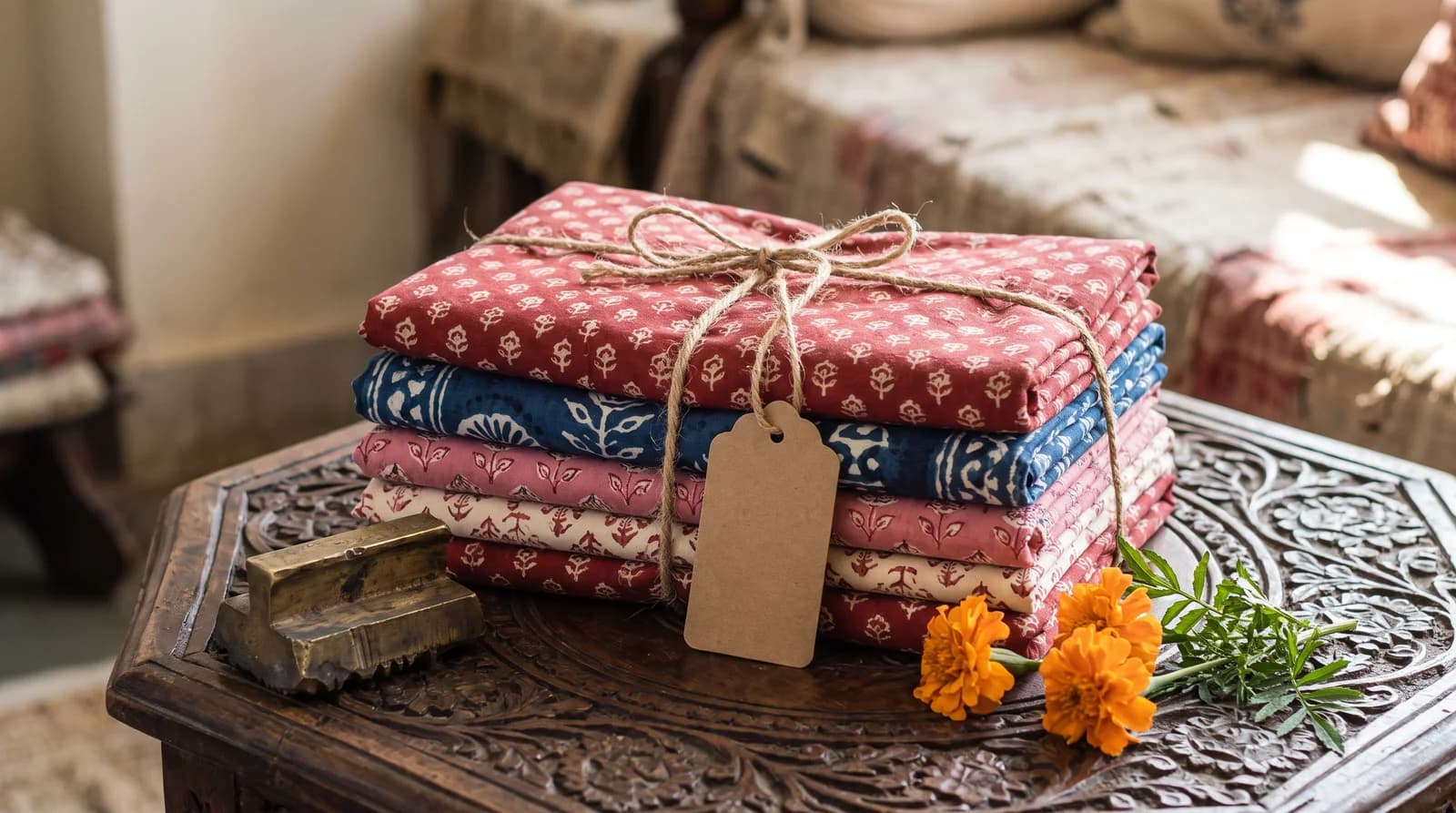
What a GI tag actually is
A Geographical Indication (GI) is a legal sign that identifies goods as originating from a specific place, where a given quality, reputation, or characteristic of those goods is essentially due to that origin. In India it is granted and protected under the Geographical Indications of Goods (Registration and Protection) Act, 1999. Think of it as a collective badge of origin owned by a whole craft community, not a trademark owned by one company.
The core idea is simple: some product names are also place-linked promises. Just as sparkling wine can only be called "Champagne" if it comes from that French region, block-printed cloth can only honestly be called "Sanganeri" if it genuinely comes from the Sanganer craft cluster near Jaipur and is made by its traditional method. A GI turns that promise into an enforceable legal right rather than mere marketing language.
| What it is | A legal origin sign for goods tied to a place |
| Governing law | GI of Goods (Registration & Protection) Act, 1999 (India) |
| Class | Textiles / handicraft goods |
| Sanganeri GI year | 2009 (certificate issued 19 March 2010) |
| Bagru GI year | 2011 (nearby village, distinct dabu / natural-dye style) |
The Sanganeri GI of 2009
"Sanganeri Hand Block Printing" was granted GI status in 2009, and the GI certificate was formally issued on 19 March 2010. It sits in the textiles and handicraft class. The registration recognises the hand block printing tradition of the Sanganer cluster on the southern edge of Jaipur, Rajasthan, as a distinct craft whose fine floral motifs, delicate registration, and printing method are rooted in that specific place and its community of printers.
The neighbouring village of Bagru received its own separate GI in 2011. This matters because Sanganeri and Bagru are often loosely lumped together, yet they are legally and technically distinct. Bagru is associated with its dabu (mud-resist) technique and earthy natural dyes, while Sanganeri is known for its finer, brighter floral printing traditionally on a lighter ground. Two villages, two crafts, two GIs. If you want the full technical contrast, see our guide on Sanganeri vs Bagru vs screen print.
| Aspect | Sanganeri GI | Bagru GI |
|---|---|---|
| GI year | 2009 (cert. 2010) | 2011 |
| Place | Sanganer, south of Jaipur | Bagru village, west of Jaipur |
| Signature style | Fine floral (buti/buta) printing | Dabu mud-resist, earthy dyes |
| Typical ground | Lighter / cream grounds | Indigo, black, natural tones |
What the GI protects, and who it benefits
The GI legally restricts the use of the name "Sanganeri" for block- or screen-printed textiles unless the goods genuinely originate from the Sanganer cluster and are made by its traditional craft. In other words, a factory in another state cannot lawfully sell machine-screen-printed yardage as "Sanganeri print" just because it copies the look. The name is protected as an indicator of true origin and method, not merely a style.
Two groups are meant to benefit. First, the artisans: printers, dyers, and block carvers of Sanganer gain a shared legal asset that protects their livelihood and reputation from cheaper imitations riding on their name. Second, the buyers: you get a recognised marker that a product claiming to be Sanganeri should actually be from the source, so you are not paying handcraft prices for a mass-printed lookalike.
- 1Protects the name
Only genuine origin goods can lawfully be marketed as "Sanganeri" hand block print.
- 2Protects the artisans
The cluster's community holds a collective right against imitators using its reputation.
- 3Protects the buyer
It gives shoppers a legal reference point to distinguish origin cloth from copycats.
The honest caveat: a GI logo alone is not a full guarantee
Here is the truth we would rather you hear from us than discover later. The Sanganeri GI is legally protective, but it has historically been under-used commercially. Many genuine artisans have never leveraged the GI for marketing or differentiation, and enforcement against imitators in the wider market is weak. As a practical result, a GI mark is not printed on every authentic piece, and its absence does not by itself prove a fabric is fake.
Unlike some crafts that run a widely-deployed per-item certificate or scannable label scheme, Sanganeri has no universal serial tag stitched onto each metre of cloth. So treat a GI logo as supporting evidence, not a magic seal. A printed "GI" badge can even be misused by a dishonest seller precisely because verification is loose. The reliable signal is a combination of trusted sourcing plus the physical hand-block craft signs, which no screen-printed copy can fully fake.
That is why we always pair GI awareness with the hands-on authenticity checks. The reverse side of true hand block cloth shows the dye striking through, and genuine hand printing carries tiny, honest misregistrations where blocks meet. Learn to read those in our detailed comparison of Sanganeri vs Bagru vs screen print, then use the GI as one more data point on top.
How to verify a real Sanganeri piece
Because there is no universal scannable serial for Sanganeri, verification is about combining a trustworthy source with your own craft checks. Here is the realistic sequence a careful buyer follows.
- 1Buy from origin or a trusted seller
Purchase from the Sanganer cluster itself or a seller who is transparent about their artisans and supply chain. Provenance is your strongest single safeguard.
- 2Ask for dye and fibre disclosure
A genuine maker can tell you the base fibre (cotton, mul, etc.) and whether the colour is natural or azo-free chemical dye. Vague answers are a warning sign.
- 3Do the reverse-side test
Flip the cloth. On true hand block printing the dye soaks through and the pattern reads clearly on the back. A crisp front with a pale, hollow back suggests surface screen printing.
- 4Look for honest misregistration
Hand-placed wooden blocks leave tiny overlaps, gaps, and slight irregularities at repeats. Machine-perfect, identical repeats across the whole length hint at screen or digital print.
- 5Confirm Sanganer provenance
Ask specifically whether the printing was done in the Sanganer cluster. Treat any GI mark as supporting evidence that complements, but does not replace, these craft checks.
Why we highlight the GI anyway
If the GI is under-used and loosely enforced, why do we bother featuring it? Because origin still matters, and someone should say so honestly. We highlight the 2009 GI to keep the Sanganer cluster's name attached to the people who actually earned it, and to give buyers a clear vocabulary for demanding real origin rather than a lookalike. Awareness is the first step toward the GI being used the way it was meant to be.
In our GI-certified Sanganeri collection we combine origin sourcing with the physical authenticity signs described above, so you are never relying on a badge alone. Our authenticity guarantee spells out exactly what we promise and how we back it. That is the honest middle path: use the GI as a meaningful reference, and prove authenticity through craft and transparent sourcing.
Frequently asked
Last reviewed: 17 May 2026 · Verified by the Sanganeri print desk
What does the Sanganeri GI tag mean?
It means "Sanganeri Hand Block Printing" is a Geographical Indication registered under India's GI Act, 1999. Legally, block- or screen-printed textiles can only be marketed as "Sanganeri" if they genuinely originate from the Sanganer craft cluster near Jaipur and follow its traditional method.
When did Sanganeri get its GI tag?
Sanganeri Hand Block Printing received GI status in 2009, and the certificate was formally issued on 19 March 2010. It is registered in the textiles and handicraft class.
Is Bagru also GI tagged?
Yes. Bagru, a nearby village, received its own separate GI in 2011. It is a distinct craft known for the dabu (mud-resist) technique and earthy natural dyes, which is why it holds a different GI from Sanganeri.
Does a GI guarantee the fabric is hand made?
Not on its own. The GI protects the name and origin, but it is historically under-used and weakly enforced, and no universal per-item label is stitched on every genuine piece. Combine GI awareness with hands-on checks like the reverse-side dye test and honest misregistration.
How do I verify a GI Sanganeri piece?
Buy from origin or a transparent seller, ask for dye and fibre disclosure, flip the cloth to confirm the print strikes through to the back, look for the tiny irregularities of hand block placement, and confirm the printing was done in the Sanganer cluster. Treat any GI mark as supporting evidence.
Is screen print allowed to be called Sanganeri?
No. Machine screen printing that merely copies the look does not qualify. The name "Sanganeri" is legally reserved for goods from the Sanganer cluster made by its hand block craft, so a screen-printed lookalike from elsewhere cannot honestly be sold as Sanganeri.
Reviewed by the Sanganeri print desk
Written and reviewed with Sanganer's printing families. Every piece we make is GI-certified Sanganeri hand block print, stamped with azo-free dyes in Sanganer, Jaipur. Last updated 12 July 2026.