Jaipuri Block Print Bedsheet Buying Guide: Sizes, Cotton & Prices
A Jaipuri bedsheet is a pure-cotton sheet hand block printed in Sanganer or Bagru near Jaipur, usually with fine buti, floral or jaal motifs on white, cream or indigo grounds. A good one is judged on cotton quality, correct bed size, genuine hand-block printing and azo-free natural dyes rather than on the lowest price.
What makes a good Jaipuri bedsheet
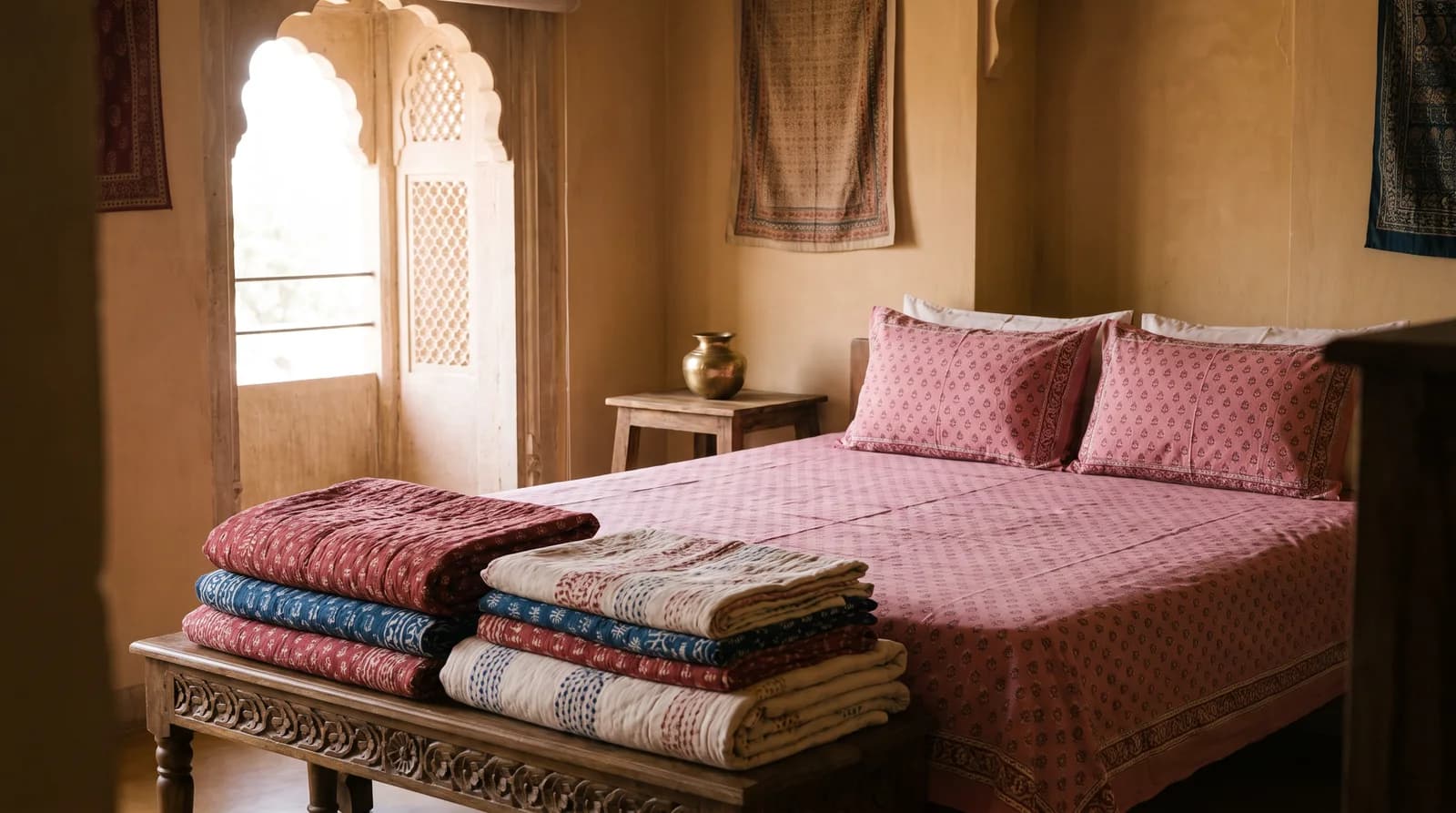
A Jaipuri bedsheet, also sold as a Sanganeri bedsheet, is a cotton sheet hand block printed by artisans in Sanganer and Bagru just outside Jaipur. The classic look is a fine buti or floral spread, a repeating jaal, or an indigo and dabu resist pattern on a white or cream ground. What you are actually buying is the combination of the cloth and the printing, not just the design on screen.
Four things separate a sheet worth keeping for years from a cheap lookalike: pure cotton cloth with a close weave, the right size for your mattress, genuine hand block printing rather than a machine screen print, and azo-free dyes that are safe on skin and hold their colour. Get those four right and the price takes care of itself. The rest of this guide walks through each one with real numbers so you can shop with confidence.
If you only remember one rule: a genuine hand-block, pure-cotton king bedsheet is never sold under about ₹1,500. Anything far cheaper is almost always a screen print or a poly-cotton blend dressed up with a Jaipuri-style pattern. Browse the full range in our block print bedsheets category to see what honest pricing looks like across sizes.
Indian bed sizes and dimensions
Bedsheet sizing in India is not standardised the way mattress sizes are, so always buy to the sheet's stated inch dimensions rather than to a label like queen or king. Measure your mattress width, length and height, then add roughly 10-12 inches on each side so the sheet tucks under. The table below covers the common Indian sizes and who each one suits.
| Size | Approx. sheet dimensions | Pillow covers | Best for |
|---|---|---|---|
| Single | 60 x 90 in | 1 | Single beds, children's rooms, hostels, guest cots |
| Double / Queen | 90 x 100 in | 2 | Standard Indian double and queen mattresses; most homes |
| King | 100 x 108 in | 2 | King beds and thicker mattresses that need deeper tuck |
| Super King | 108 x 108 in and above | 2 | Extra-wide king frames and joined mattresses |
A "double bedsheet" in India almost always means the 90 x 100 inch size with two pillow covers, which fits the majority of double and queen mattresses at home. If your mattress is on the taller side, size up to king so the corners still reach under. See fitted-ready options in our double bed block print collection, and for larger frames browse the king size block print bedsheets.
One practical tip: cotton shrinks a little on the first wash, typically 2-4 percent, so a snug-fitting sheet can feel tight after laundering. Buying the next size up, or choosing pre-washed cotton, avoids that problem entirely.
How to judge the cotton
The base cloth matters more than the print. Genuine Jaipuri bedsheets use pure cotton, most often in one of three weaves: cambric, a smooth medium-weight everyday cotton; percale, a crisp closely-woven cotton that feels cool and hotel-like; or mulmul, a soft lightweight muslin that is airy for summer. Each breathes and softens with every wash, which is exactly why cotton is worth paying for.
- 1Check the fibre content
Look for "100% cotton" or "pure cotton" clearly stated. Poly-cotton blends feel slightly slick and plasticky, do not breathe as well, and tend to pill over time. If a listing avoids naming the fibre, treat that as a red flag.
- 2Feel the weave, not the thread-count number
Indian block print cottons are rarely sold by thread count, and inflated thread-count claims are meaningless on loose weaves. Instead, hold the cloth to the light: a good sheet has a close, even weave with no gappy see-through patches.
- 3Judge GSM to the season
GSM (grams per square metre) tells you weight. Roughly 120-150 GSM suits light summer mulmul, while 150-200 GSM gives an everyday cambric or percale that drapes well and lasts. Heavier is not automatically better; it is about matching weight to use.
- 4Do the crumple and drape test
Scrunch a corner in your fist and release. Pure cotton creases and holds a soft crumple; heavy synthetic springs back stiffly. Good cotton also drapes and folds softly rather than standing away from the mattress.
- 5Smell and touch for finish
Fresh cotton smells neutral or faintly of natural dye. A strong chemical or waxy smell can mean heavy sizing or synthetic content that washes out into a thinner, poorer sheet.
In short, trust your hands. A pure-cotton Jaipuri sheet feels cool, matte and substantial, softens on the first few washes, and stays comfortable in Indian heat in a way no blend can match.
Hand block vs screen print
This is where most buyers get caught. A large share of sheets marketed as "Jaipuri" are actually machine screen prints made to look like block print. They are a different, cheaper product. Telling them apart takes about ten seconds once you know what to look at.
- 1Turn the sheet over
This is the single best test. On a genuine hand block print the dye soaks through, so the motif is clearly visible on the reverse, only slightly softer. On a screen print the back is pale, blank or a faint ghost, because the ink sits on the surface.
- 2Look for tiny irregularities
Hand blocks are stamped one impression at a time, so you will see gentle variation: a motif slightly off-register, a joint in the repeat, a hair more ink in one corner. Screen prints are machine-perfect and identical across the whole sheet, which is the giveaway of a mass print.
- 3Check the register lines
In multi-colour block printing, outline and fill are separate blocks. A tiny overlap or gap where colours meet is a sign of real hand work, not a defect.
- 4Ask about the dye
Genuine Sanganeri and Bagru printing uses azo-free and often natural dyes, which matter for skin safety and colourfastness. Look for an azo-free or GI-certified claim; a seller who cannot say what dye was used usually did not choose a good one.
If you want the full breakdown of how these processes differ, and why Bagru's dabu mud-resist looks different from Sanganeri's fine floral, read our guide on Sanganeri vs Bagru vs screen print. It is the fastest way to train your eye. For dye-first shopping, our natural dye collection and GI-certified Sanganeri range only feature genuine hand-printed cloth.
Honest price bands by size
Genuine hand block printing is labour: carving the wooden blocks, stamping every repeat by hand, dyeing, washing and drying in the sun. That is why a real Jaipuri bedsheet costs more than a machine-printed one, and why suspiciously cheap "hand block" listings are almost always screen prints. The bands below are realistic 2026 prices for pure-cotton, genuinely hand-block-printed sheets.
| Single (60 x 90 in) | ₹700 - ₹1,200 |
| Double / Queen (90 x 100 in) | ₹1,200 - ₹2,200 |
| King (100 x 108 in) | ₹1,600 - ₹3,000 |
| Hard floor for a genuine hand-block king | Never under ₹1,500 |
Where a sheet sits inside its band depends on the cotton weave, the number of colours and blocks in the design, whether the dyes are natural, and whether it carries GI certification. A fine multi-colour Sanganeri jaal on percale sits at the top of its range; a simple two-colour buti on cambric sits nearer the bottom. Both are honest products.
Be wary of a king sheet advertised at ₹499 or ₹699. At that price the cloth is thin poly-cotton and the pattern is screen printed, no matter what the title says. There is nothing wrong with buying a budget screen print if that is what you want, but it is not the same thing as a hand-block sheet, and it will not wear or breathe the same way. We do not run fake discounts on our block print bedsheets; the price you see reflects the real cost of the craft.
First wash and everyday care
Natural and azo-free dyes are safe and long-lasting, but they can release a little excess colour on the very first wash. That is normal for hand-dyed cotton and settles quickly. For the first wash, use cold water, a mild detergent, and wash the sheet separately or with similar colours. Skip bleach and harsh whiteners entirely.
After that, cold or lukewarm machine wash on a gentle cycle is fine. Always dry in the shade rather than harsh direct sun, which fades any natural dye over time, and the sheet will actually grow softer with each wash. Done right, a good Jaipuri cotton sheet stays comfortable for years.
For a full routine, including how to handle indigo and dabu prints and how to keep whites bright without bleach, see our block print care and washing guide.
Frequently asked
Last reviewed: 17 May 2026 · Verified by the Sanganeri print desk
What size is a double bedsheet in India?
A double bedsheet in India is most commonly about 90 x 100 inches and comes with two pillow covers. This fits standard double and queen mattresses in most homes. If your mattress is unusually tall or wide, size up to king (around 100 x 108 in) so the corners still tuck under.
Are Jaipuri bedsheets pure cotton?
Genuine Jaipuri and Sanganeri bedsheets are pure cotton, usually in cambric, percale or mulmul weaves that breathe well and soften with washing. Cheaper lookalikes are sometimes poly-cotton blends, which feel slightly slick and pill over time. Always check the listing states "100% cotton" before buying.
How do I tell hand block from screen print bedsheet?
Turn the sheet over. On a real hand block print the dye soaks through, so the motif shows clearly on the reverse. On a screen print the back is pale or blank because the ink sits on the surface. Also look for small natural irregularities in the print; machine-perfect uniformity means screen printing.
Why are Jaipuri bedsheets priced higher?
Because real hand block printing is skilled manual work: carving wooden blocks, stamping every repeat by hand, and dyeing, washing and sun-drying the cloth. That labour, plus pure cotton and azo-free dyes, costs more than a machine screen print. A genuine hand-block king sheet is never sold under about ₹1,500.
Do Jaipuri bedsheets bleed colour?
A little excess dye can release on the first wash, which is normal for natural and hand-dyed cotton and settles quickly. Wash the sheet in cold water with mild detergent, separately the first time, and dry in the shade. After the first couple of washes the colour is stable.
King vs queen bedsheet, which should I buy?
Buy to your mattress, not the label. A queen sheet (about 90 x 100 in) suits standard double and queen beds. Choose king (about 100 x 108 in) for wider king frames or thicker mattresses that need a deeper tuck. When in doubt, size up, since cotton shrinks slightly on washing.
Reviewed by the Sanganeri print desk
Written and reviewed with Sanganer's printing families. Every piece we make is GI-certified Sanganeri hand block print, stamped with azo-free dyes in Sanganer, Jaipur. Last updated 12 July 2026.