Ajrakh Hand Block Print: What It Is, Where It Comes From, and How to Recognise It
Ajrakh is a resist-dye block printing craft known for geometric, symmetrical motifs in deep indigo and madder red. Cloth is printed with resist paste from carved blocks, then dyed in vats in repeated stages. Its traditional home is Kutch in Gujarat and Sindh, with practitioners also in Barmer, Rajasthan. It is not a Sanganer craft.
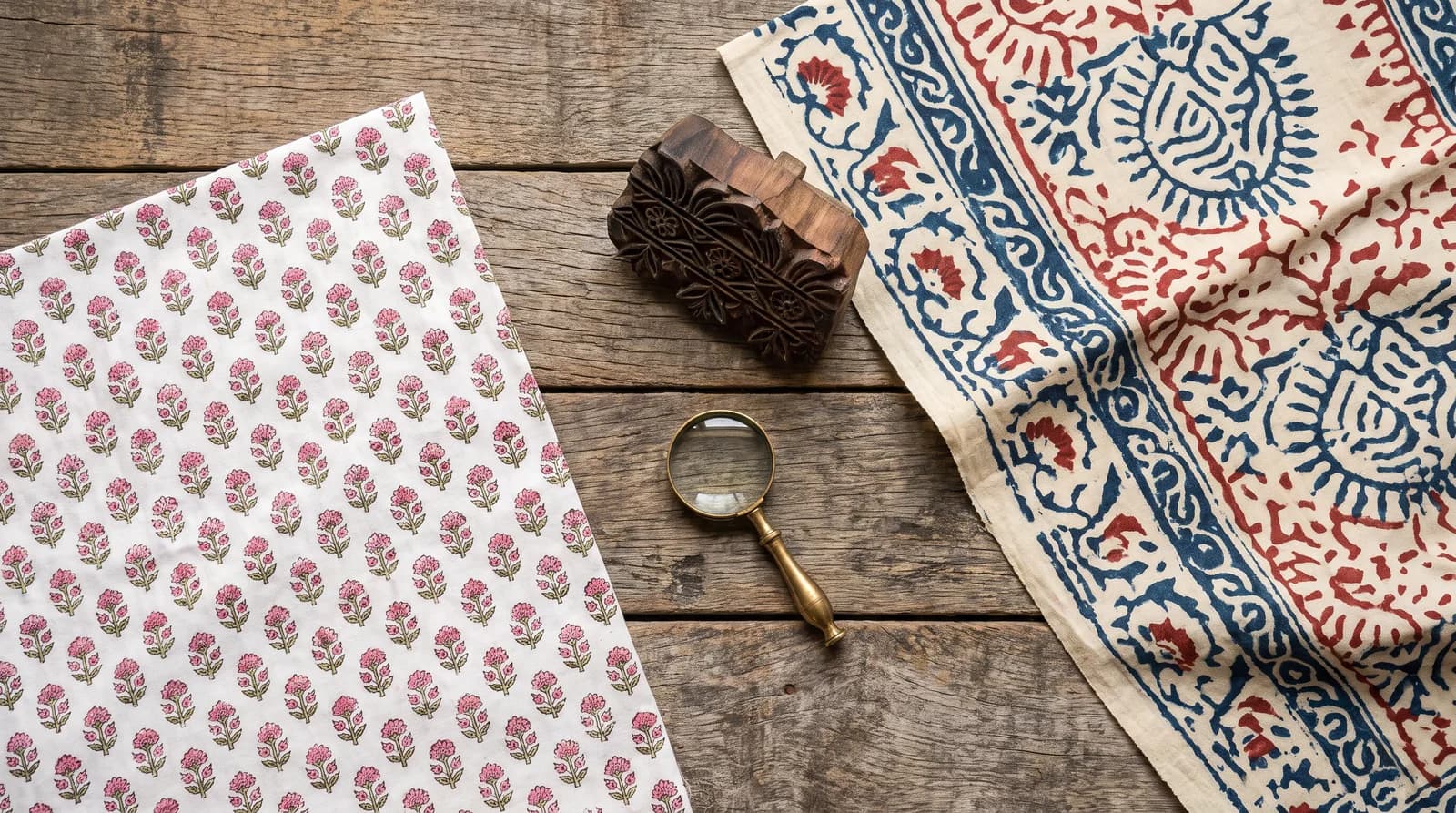
What is Ajrakh hand block print?
Ajrakh is a hand block printing craft that uses resist dyeing rather than direct printing. A printer stamps a carved wooden block into a resist paste, and wherever that paste sits, dye cannot reach the cloth. The cloth is then dyed, and the process repeats until the full design is built up. The result is a pattern of geometric, symmetrical motifs, most often in deep indigo and madder red.
The word Ajrakh is used both for the craft and for the finished cloth. Ajrakh pieces are usually recognised by their dense, orderly geometry and by the depth of their blue. Madder gives the reds and maroons that sit beside the indigo in most traditional designs.
| Technique | Block-applied resist dyeing, then dyeing in indigo and madder |
| Motif style | Geometric, symmetrical, densely arranged |
| Main colours | Deep indigo blue and madder red |
| Traditional home | Kutch (Gujarat) and Sindh; also Barmer (Rajasthan) |
| Sanganer connection | None. Ajrakh is not a Sanganer craft |
Origin: Kutch, Sindh and Barmer, not Sanganer
Ajrakh has its roots in the arid western regions of the subcontinent. Its traditional centre is Kutch in Gujarat, and the craft has long been linked with Sindh, now in Pakistan. Printers and dyers in Barmer, in western Rajasthan, also practise Ajrakh, so the craft is part of Rajasthan's textile life as well as Gujarat's.
This matters for buyers. Sanganeri print comes from Sanganer, near Jaipur, and has its own fine floral tradition. Ajrakh belongs to a different place, a different set of motifs and a different technique. Calling Ajrakh a Sanganeri print would be wrong, and it would also misdescribe what the craft is.
Ajrakh has its own craft tradition and protections. This guide does not claim a Geographical Indication tag for Ajrakh. Where a piece is sold, the name of the craft and its place of origin should be stated plainly on the label or listing.
How Ajrakh is printed and dyed
Ajrakh is slower than direct printing because colour is built up in stages. Each stage adds a layer of pattern, and the cloth is washed between them. The steps below describe the general sequence. Practice varies between workshops and families, so treat this as an outline rather than a fixed recipe.
- 1Preparing the cloth
The cotton is cleaned and prepared so that it takes dye evenly. This preparation is a key part of the craft, because the colour can only bond well to a clean, receptive ground.
- 2Applying the resist
Printers stamp carved blocks dipped in a resist paste, traditionally based on lime and gum. The paste blocks the dye in the areas it covers, so those parts of the cloth stay pale when the cloth is dyed.
- 3Mordanting
Mordants are applied to set areas of the cloth so that the dye bonds to the fibre and holds. The placement of mordants is one of the things that gives Ajrakh its precise, layered look.
- 4Indigo dyeing
The cloth is dipped in indigo vats. Indigo gives the deep blue that is central to most traditional Ajrakh, and the depth builds with each dip.
- 5Madder dyeing
Madder root dye produces the reds and maroons. Resist and dye stages alternate, so the motifs layer over one another across the cloth.
- 6Washing in running water
The cloth is washed in running water to remove the resist paste and loose dye. This is when the pattern reveals itself, and the washing is repeated as each stage completes.
Ajrakh is often printed on both sides. Because the resist must reach through the cloth, the design can be made to read well on either face, which is one reason the craft demands such careful alignment of blocks.
Ajrakh vs Sanganeri print vs Bagru
Ajrakh is often confused with other block-printed cloth from Rajasthan and Gujarat. The three crafts below sit close together on a shelf, but each has its own technique, look and home. Bagru is a neighbour of Sanganer, and the two are the most frequent mix-up.
| Ajrakh | Sanganeri print | Bagru | |
|---|---|---|---|
| Where it comes from | Kutch (Gujarat), Sindh; also Barmer (Rajasthan) | Sanganer, near Jaipur, Rajasthan | Bagru, near Jaipur, Rajasthan |
| Core technique | Block-applied resist, then indigo and madder dye | Hand block printing with fine colour impressions | Black and red syahi-begar prints and dabu mud-resist |
| Motif style | Geometric, symmetrical, dense | Fine floral buti, buta and bel | Earthy, bold block motifs and mud-resist patterns |
| Typical colours | Deep indigo and madder red | Bright colours on white or cream | Black and red on natural grounds |
| Ground | Usually cotton with resist patterns | Typically white or cream cotton | Typically natural cotton |
The simplest rule is this. If the motif is a fine flower on a light ground, it is Sanganeri. If it is a geometric pattern built from indigo and madder, it is Ajrakh. If the cloth is black and red, or shows a mud-resist pattern, it belongs to the Bagru family. For more on the first two, see the comparison guide linked below.
sanganeri.in carries an Ajrakh, Bagru and Dabu edit of selected pieces. Each one is labelled with its own craft name and origin. Nothing in that edit is called Sanganeri unless it is Sanganeri.
How to identify genuine Ajrakh
Genuine Ajrakh is hard to judge from a photograph, so it helps to know what to look for, both in the cloth and in the seller's description. None of the signs below is a guarantee on its own. Together they give a fair picture.
- 1Read the label
A good listing names the craft as Ajrakh and states where it was made. Vague terms such as Ajrakh-style or Ajrakh-inspired usually describe a printed look-alike.
- 2Look at the geometry
Ajrakh motifs are geometric and symmetrical. A fine floral buti on a light ground is a Sanganeri-style design, not Ajrakh, whatever the colour.
- 3Check the reverse
Because the pattern is built through the cloth, the back often shows the design too, sometimes slightly softer than the front. A flat print that looks identical on both sides with no depth may be a screen print.
- 4Judge the colour
Natural indigo and madder have tonal depth and small variations across the cloth. Very uniform, flat colour is a reason to ask more questions before buying.
- 5Ask the seller
Ask which craft the piece is, where it was made, and what dyes were used. A seller who knows their stock will answer directly.
How to care for Ajrakh cloth
Natural dyes reward gentle handling. Ajrakh that is washed carefully keeps its character for longer, and its colours mellow into softer tones over time. That softening is a normal feature of natural dye, not a fault.
| Washing | Cold water with a mild detergent |
| First wash | Wash new Ajrakh separately, because natural dyes can release some colour early |
| Drying | Shade dry rather than in direct sun |
| Colour over time | Natural indigo and madder mellow tonally; this is expected |
Avoid soaking Ajrakh for long periods and do not wash it with bright, unrelated fabrics. If a piece is for everyday use, wash it more often in cold water rather than hot, and dry it in the shade to protect the colour.
Frequently asked
Last reviewed: 17 May 2026 · Verified by the Sanganeri print desk
What is Ajrakh print?
Ajrakh is a hand block printing craft that uses resist dyeing. Carved blocks apply a resist paste, and the cloth is then dyed in indigo and madder. It is known for geometric, symmetrical motifs in deep blue and red, and it has its own traditional centres in Kutch and Sindh.
Is Ajrakh a Sanganeri print?
No. Sanganeri print comes from Sanganer, near Jaipur, and is known for fine floral block printing. Ajrakh is a separate craft with its own origin and technique. It should never be labelled Sanganeri.
Where is Ajrakh made?
The traditional centres of Ajrakh are Kutch in Gujarat and Sindh. Practitioners in Barmer, Rajasthan, also make Ajrakh. Any piece should state its craft name and place of origin clearly.
What is the difference between Ajrakh and Bagru?
Ajrakh uses resist dyeing with indigo and madder, producing geometric, symmetrical motifs. Bagru is known for black and red syahi-begar prints and dabu mud-resist work, from Bagru near Jaipur. The motifs, colours and techniques are different.
Is Ajrakh a GI-tagged craft?
This guide does not claim a Geographical Indication tag for Ajrakh. Sanganeri print holds a GI tag granted in 2009. Ajrakh has its own craft tradition and protections, and the craft name and origin should be stated on every piece.
How can I tell genuine Ajrakh from a printed copy?
Check the label first, then the geometry and the colour. Genuine Ajrakh has symmetrical geometric motifs and natural depth in its indigo and madder. A flat, uniform print with a vague label such as Ajrakh-style is a reason to ask more questions.
Does Ajrakh print on both sides?
Often, yes. Because the resist and dye reach through the cloth, the pattern can be made to read on both faces. The back may be slightly softer in tone than the front.
How should I wash Ajrakh?
Wash Ajrakh in cold water with a mild detergent, and wash new pieces separately at first. Dry it in the shade rather than in direct sun. Natural dyes mellow over time, and that softening is normal.
Reviewed by the Sanganeri print desk
Written and reviewed with Sanganer's printing families. Every piece we make is GI-certified Sanganeri hand block print, stamped with azo-free dyes in Sanganer, Jaipur. Last updated 13 October 2026.