Dabu Printing Explained: The Mud-Resist Indigo Hand Block Technique
Dabu is a hand block printing technique from Rajasthan that uses a resist. A paste of mud, often mixed with lime and gum, is stamped onto cloth with a carved block. The cloth is then dipped in dye, classically vat indigo. Where the mud sits, the dye cannot reach the fibres, so the pattern appears pale when the mud is washed off. It is strongly linked to Bagru, near Jaipur.
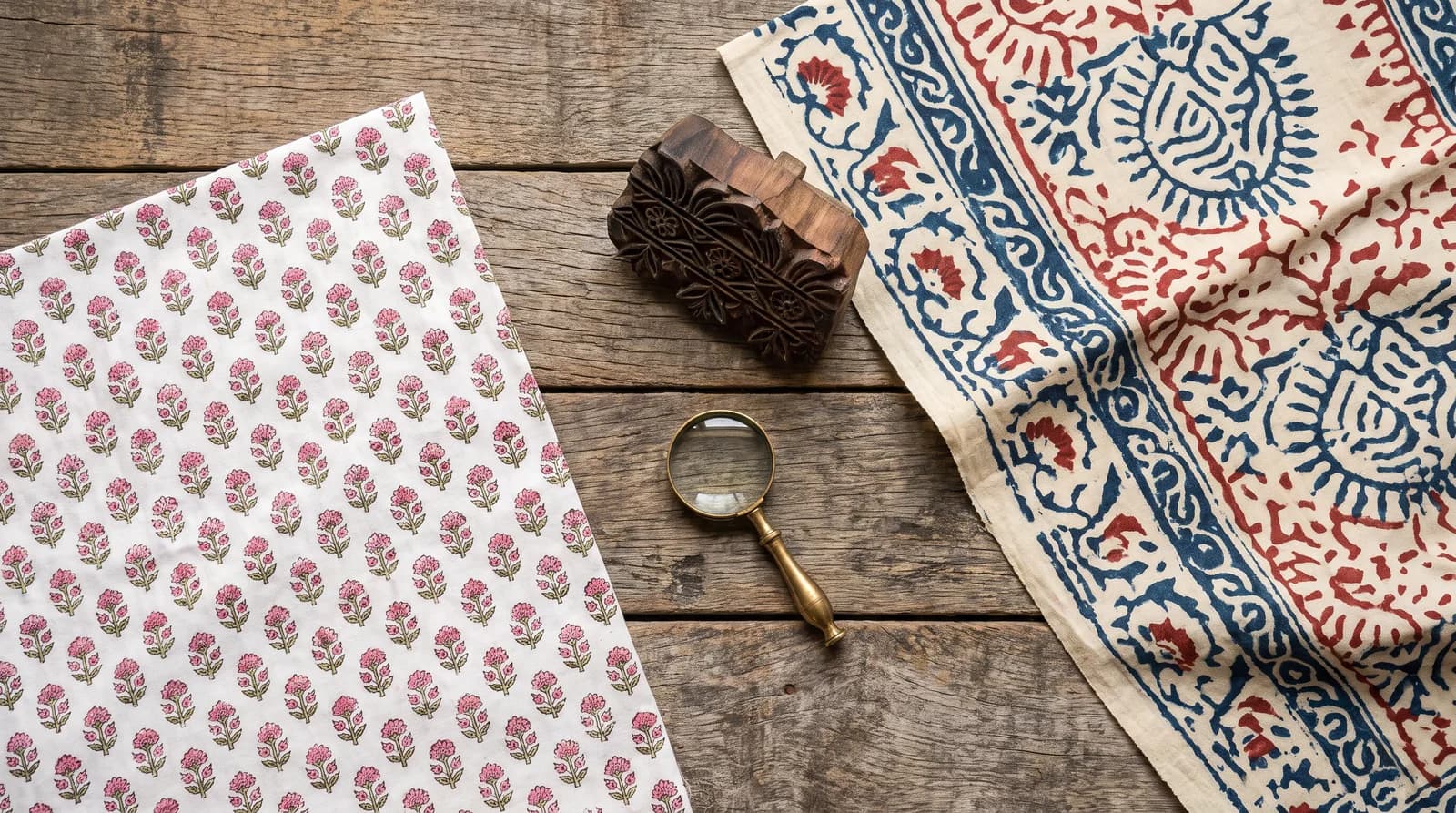
What is dabu printing?
Dabu is a resist printing technique from Rajasthan. Instead of printing colour onto cloth, the printer stamps a paste of mud onto the fabric with a carved wooden block. Where the mud sits, the dye cannot reach the cloth. The pattern is revealed when the mud is washed off, leaving pale motifs on a deep ground. The skill lies in the paste and in placing each stamp, because the colour is decided by what the mud keeps out.
The technique is strongly associated with Bagru, a village near Jaipur. Similar mud-resist traditions are also found in other parts of Rajasthan and in Madhya Pradesh. The result is a soft, earthy print on a dark ground, very different from the light, fine florals of Sanganeri print.
| Technique | Mud-resist block printing |
| Resist paste | Mud, often with lime, gum and other binders |
| Dye | Classically vat indigo; natural dyes are also used |
| Ground | Deep indigo, with pale motifs where the resist sat |
| Strongly linked to | Bagru, near Jaipur, Rajasthan |
| Each piece | Unique; no two match exactly |
How the mud resist works
Dabu is simple in idea and exacting in practice. The resist is what makes the pattern, so the paste must be prepared and applied with care. The steps below describe the sequence rather than fixed timings, because drying and dyeing depend on the workshop and the weather.
- 1Prepare the resist
The mud is mixed into a paste with binders such as lime and gum. Its consistency decides how cleanly it holds the edge of the block.
- 2Stamp the block
The printer presses a carved wooden block into the paste and stamps the motif onto the cloth. The mud forms the pattern in reverse: wherever it sits, the dye will be blocked.
- 3Dust, where used
Some printers dust the wet paste with sawdust. This changes how the resist sits on the cloth and adds to the texture of the finished print.
- 4Dry the cloth
The cloth is dried so the resist sets. Rushing this step can smear the pattern.
- 5Dip in dye
The cloth is dipped in the dye, classically indigo vat. Where the mud sits, the dye cannot reach the fibres.
- 6Wash out the mud
The mud is washed away, revealing the pale pattern on the coloured ground. The cloth is rinsed and dried.
Why dabu is usually dyed in indigo
Indigo is the classic dye for dabu. In a vat, indigo is reduced into a soluble form. The cloth is dipped, and the colour develops as it meets air, moving from greenish-yellow to blue. Repeated dips build depth. The fabric is not painted on the surface; the colour is taken up by the fibres, which is why the dark ground looks rich rather than flat.
Vat indigo is slow and sensitive to temperature and chemistry, so each batch behaves a little differently. That is part of why the blue of one dabu piece never matches another exactly. Natural indigo also tends to soften and change tone with use and light over time, which many buyers prefer.
Why no two dabu pieces match
Dabu is handwork at every stage, and each stage has variables. The paste is never exactly the same, the block is pressed with a slightly different force each time, the mud settles differently on the cloth, and every dip shifts the tone a little. The result is a soft, slightly uneven look that a machine print does not have.
Look for these signs of the hand: a slight crackle or bleed at the edge of the resist, tonal depth that varies across the cloth, and motifs that are not perfectly repeated. These are not defects. They show that a person made the piece. A buyer who wants identical panels should say so before ordering, and should expect some variation even then.
Dabu, Sanganeri and Ajrakh: how they differ
These three Indian block-print traditions are often confused, because all of them use hand-carved blocks and traditional dyes. The method is what separates them. At sanganeri.in we label each piece by its real technique. A dabu piece is called dabu, not Sanganeri.
| Dabu | Sanganeri print | Ajrakh | |
|---|---|---|---|
| Core method | Mud resist blocks the dye | Direct block printing of colour | Multi-stage resist dyeing with geometric blocks |
| Typical ground | Deep indigo | White or cream cotton | Deep indigo and madder |
| Motif style | Motifs stamped in pale resist | Fine floral buti, buta, jaal and bel | Geometric, symmetrical patterns |
| Dyes | Vat indigo or natural dyes | Pigments or natural dyes on a light ground | Indigo and madder |
| Home region | Bagru, near Jaipur, Rajasthan | Sanganer, near Jaipur, Rajasthan | Kutch and Sindh |
How to identify real dabu
A lot of printed cloth is sold with a dabu look. A resist print behaves differently from a screen print, so the marks give it away. Check the following before you buy, and ask the seller how the piece was made.
- 1Check the edges
A resist print has soft, slightly irregular edges and sometimes fine crackle lines. A screen print usually has crisp, identical edges across every repeat.
- 2Compare the repeats
Hand-stamped repeats drift slightly. Look across the cloth for small differences in spacing and tone.
- 3Ask about the dye
Ask whether the blue is indigo and whether the dye is natural or synthetic. A reputable seller will state it, as we do for our natural-dye products.
- 4Ask how it was made
A seller who calls a piece dabu should be able to say that a mud resist was used. A machine print with a dabu-style design should be described as that.
How to care for dabu
Indigo can release some colour in the first few washes, especially on a deep, freshly dyed piece. Wash new dabu separately from light colours, in cold water, for the first few washes. Use a mild detergent, rinse well, and do not wring hard, since twisting can distort the print. After the early washes, cool water and a mild detergent remain the safer choice for natural dyes.
| First washes | Cold water, separate from light colours |
| Drying | In the shade, not in direct sun |
| Avoid | Bleach and chlorine |
| Storage | Dry, and away from strong light |
Our Indigo Dabu collection includes a king quilted bedcover set in dabu indigo with a natural-dye face, priced at ₹6,499. Our natural-dye king bedsheets are priced from ₹3,999 to ₹4,499, and the dye source is disclosed on each listing.
Frequently asked
Last reviewed: 17 May 2026 · Verified by the Sanganeri print desk
What is dabu printing?
Dabu is a mud-resist hand block printing technique from Rajasthan. A paste of mud is stamped onto cloth, the cloth is dyed, often in indigo, and the mud is washed away to leave the pattern pale against the coloured ground. It is most closely linked to Bagru, near Jaipur.
Is dabu the same as Sanganeri print?
No. Sanganeri print is fine floral block printing, with colour applied directly onto a light ground, from Sanganer near Jaipur. Dabu is a resist technique that produces a deep ground, and it is linked to Bagru. Both are hand block printed, which is why they are often confused.
Is dabu printing made with natural dye?
Dabu is often dyed in vat indigo, which is a natural dye, but not every dabu piece is natural. Check the listing for the dye source. Our natural-dye products disclose their dye source.
Why does my dabu print look uneven?
Hand resist printing is uneven by design. Small variations in the mud paste, the block pressure and each indigo dip change the tone and the edges. A slight crackle at the resist line and variation between repeats are normal signs of hand work, not faults.
How do I wash a dabu print bedsheet?
Wash new dabu separately in cold water for the first few washes, using a mild detergent. Rinse well, do not wring hard, and dry in the shade. Avoid bleach and chlorine. Indigo can bleed in early washes, so keep it apart from light-coloured laundry.
Where does dabu printing come from?
Dabu is strongly associated with Bagru, a village near Jaipur in Rajasthan. Similar mud-resist work is also found in other parts of Rajasthan and in Madhya Pradesh. Bagru and Sanganer are both near Jaipur, but they are separate traditions with different methods.
What is the difference between dabu and Ajrakh?
Dabu uses a mud paste resist, usually with indigo vat dyeing, to leave pale motifs on a dark ground. Ajrakh uses several resist and dye stages to build geometric patterns in indigo and madder, traditionally from Kutch and Sindh.
How can I tell if a print is real dabu?
Look for soft, slightly irregular edges, a little crackle at the resist line, and small differences between repeats. Crisp, identical repeats often point to a screen print. Ask the seller how the piece was made and what dye was used.
Reviewed by the Sanganeri print desk
Written and reviewed with Sanganer's printing families. Every piece we make is GI-certified Sanganeri hand block print, stamped with azo-free dyes in Sanganer, Jaipur. Last updated 13 October 2026.